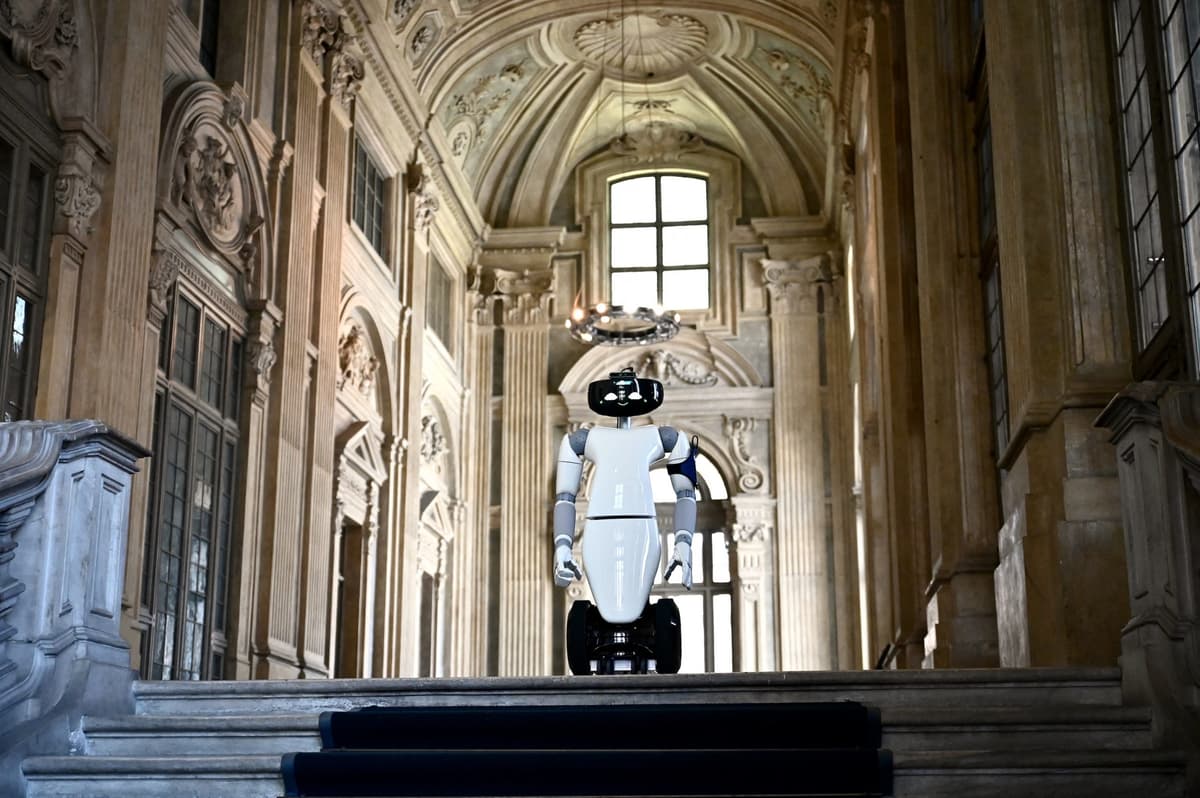
The Newest Docent at This Historic Italian Palace Is a Robot
Why It Matters
The deployment showcases how AI can augment cultural institutions, improving visitor engagement while proving autonomous navigation in high‑value, crowd‑dense environments. It signals a broader shift toward tech‑enhanced museum experiences across Europe and beyond.
Key Takeaways
- •R1 robot guides visitors through Turin's Palazzo Madama
- •Project Convince funded with €4 million EU grant
- •R1 operates autonomously for two‑hour tours, navigating crowds
- •AI docent learns on the job, correcting localization errors
- •Human staff remain; robot supplements visitor experience
Pulse Analysis
Museums worldwide are experimenting with artificial intelligence to deepen audience interaction, and Italy’s Palazzo Madama is at the forefront. The R1 robot, a product of the Italian Institute of Technology’s Project Convince, blends computer vision, natural‑language processing, and autonomous navigation to act as a mobile docent. Funded by a €4 million ($4.7 million) European Union grant, the initiative tests whether a machine can safely operate among priceless artworks while handling variable visitor flows and spotty Wi‑Fi connectivity.
The technology behind R1 reflects a broader trend of AI‑driven cultural services. Similar deployments at Versailles and Berlin’s Palais Populaire demonstrate that institutions are leveraging chat‑based interfaces and robotic guides to personalize tours, answer on‑demand queries, and manage crowd density. R1’s two‑hour battery life and ability to relocalize using wall‑based visual cues illustrate how advances in simultaneous localization and mapping (SLAM) are making robots viable in complex, unstructured spaces. By completing 30 tours in December 2025, the robot proves that continuous learning on the job can reduce the need for constant human supervision.
For the museum sector, R1’s rollout offers a proof point that AI can augment, not replace, human expertise. Staff can focus on curatorial depth and visitor services while the robot handles routine introductions and navigation assistance. This hybrid model may lower operational costs, attract tech‑savvy audiences, and set new standards for accessibility, especially in multilingual contexts. As European cultural bodies continue to allocate funding toward digital innovation, the success of R1 could accelerate adoption of autonomous guides across heritage sites, reshaping how history is presented to the public.
The Newest Docent at This Historic Italian Palace Is a Robot
Comments
Want to join the conversation?
Loading comments...