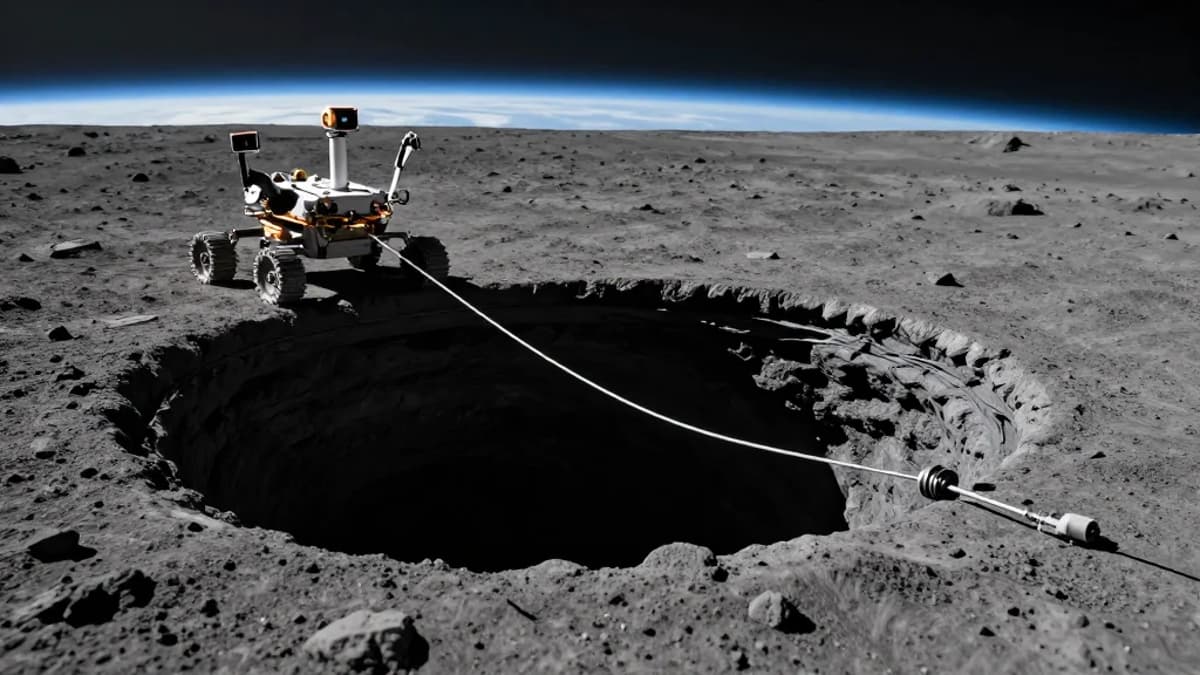
The Origami Wheel that Could Explore Lunar Caves
•December 29, 2025
0
Companies Mentioned

NASA
Why It Matters
The wheel gives compact rovers the climbing ability of larger vehicles, opening lunar caves for scientific study and reducing mission‑failure risk for commercial and agency explorers.
Key Takeaways
- •Origami wheel expands from 230 mm to 500 mm diameter.
- •No hinges; elastic frame and fabric tensioners enable flex.
- •Survived simulated lunar regolith test and 100 m drop.
- •Thermal models ensure operation across 300 °C lunar swings.
- •Allows small rovers to reach caves, lowering mission risk.
Pulse Analysis
Lunar lava tubes and pit craters are among the most coveted targets for next‑generation exploration because they offer natural shielding from radiation and extreme temperature swings. Yet their entrances are riddled with jagged rocks and loose regolith that defeat conventional small‑rover wheels, forcing agencies to rely on bulky, single‑point landers that raise cost and risk. The need for a compact mobility solution that can adapt to harsh terrain has become a strategic priority for both government and commercial lunar programs.
The newly demonstrated origami wheel draws on Leonardo da Vinci’s self‑supporting bridge concepts and modern folding geometry to eliminate traditional mechanical joints that suffer from cold‑welding and dust infiltration in the Moon’s vacuum. An elastic metal skeleton paired with fabric tensioners expands the wheel’s diameter by more than 100 %, providing the ground clearance needed to surmount obstacles while retracting for launch efficiency. Rigorous testing in artificial lunar soil confirmed high traction on loose slopes and resilience to impact forces equivalent to a 100‑meter fall under lunar gravity, while thermal modeling guarantees performance across the Moon’s 300 °C day‑night temperature swing.
If integrated into swarms of lightweight rovers, this technology could democratize access to subterranean lunar environments, accelerating scientific discovery of pristine geological records and supporting the construction of habitats within natural caves. The approach also aligns with emerging commercial lunar initiatives that favor modular, reusable hardware. Remaining hurdles include power management, autonomous navigation, and reliable communications within deep pits, but the wheel’s success positions its developers as front‑runners for upcoming Artemis and private lunar missions.
The origami wheel that could explore lunar caves
0
Comments
Want to join the conversation?
Loading comments...