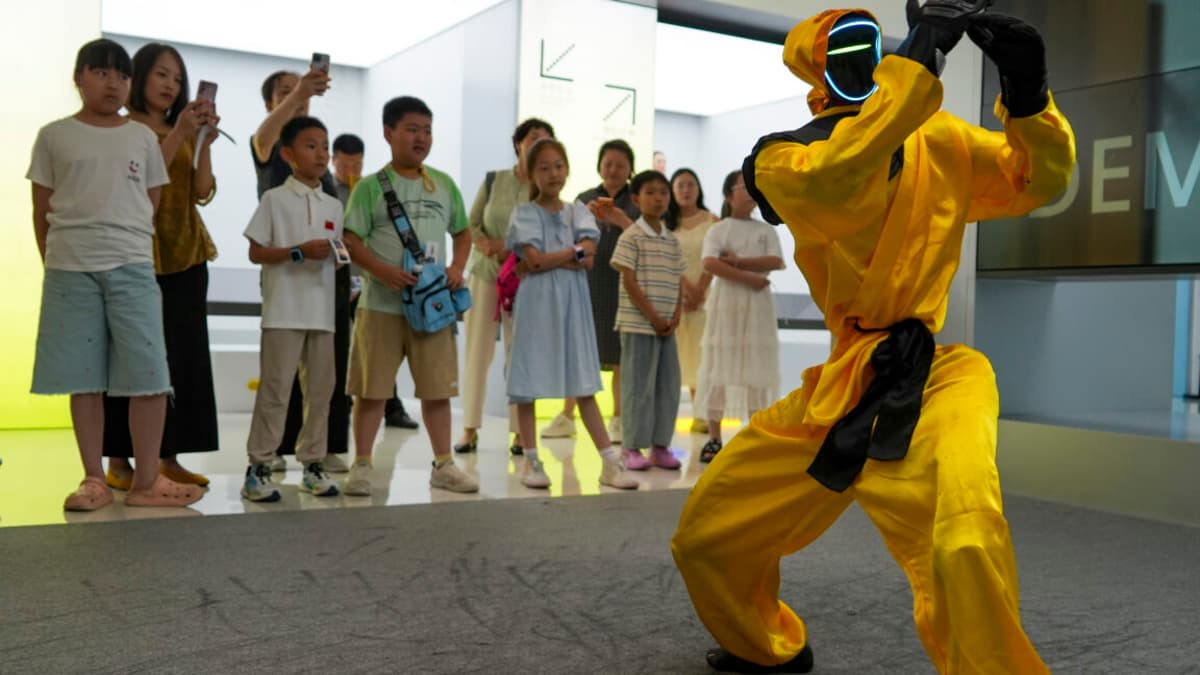
The Skeptic’s Guide to Humanoid Robots Going Viral on the Internet
Companies Mentioned
Why It Matters
Misleading demos can skew market expectations, driving premature funding into unproven technology. Clear, transparent metrics are essential for sustainable growth in the robotics sector.
Key Takeaways
- •Humanoid demos often rely on teleoperation, not full autonomy
- •Performance often sped up; real‑time speed may be much slower
- •Generalization across environments remains unproven in most demos
- •Viral videos can inflate investor expectations and funding rounds
- •Quantitative large‑scale testing needed to gauge true capability
Pulse Analysis
The recent surge of viral humanoid robot clips taps into a deep human tendency to anthropomorphize machines, turning a technical showcase into a pop‑culture moment. Companies leverage these eye‑catching videos to attract media attention, boost brand visibility, and court investors who may equate a backflip or a choreographed dance with commercial readiness. However, the underlying technology often depends on remote operators, pre‑programmed scripts, or playback acceleration, creating a perception gap that can inflate valuations and misguide strategic decisions across the AI‑robotics ecosystem.
From a technical standpoint, the core challenge lies in achieving true generalization—enabling a robot to perform a task reliably across varied objects, lighting, and layouts without retraining. Researchers like Sergey Levine stress that a single demo cannot capture the stochastic nature of real‑world environments, where friction, sensor noise, and unexpected obstacles abound. Large‑scale, quantitative evaluations—running thousands of trials in uncontrolled settings—are the benchmark for progress, yet few firms publish such data. Moreover, the distinction between teleoperated control and autonomous decision‑making is frequently blurred, leaving stakeholders uncertain about the actual level of AI integration.
For investors and industry leaders, the takeaway is caution tempered with curiosity. Transparent reporting of metrics, open‑source datasets, and third‑party validation can differentiate genuine breakthroughs from marketing hype. As standards for robotic performance emerge, companies that prioritize reproducibility and real‑world testing will likely secure more sustainable capital and partnerships. In the meantime, consumers and analysts should view viral robot videos as a teaser, not a definitive proof of market‑ready technology.
The skeptic’s guide to humanoid robots going viral on the Internet
Comments
Want to join the conversation?
Loading comments...