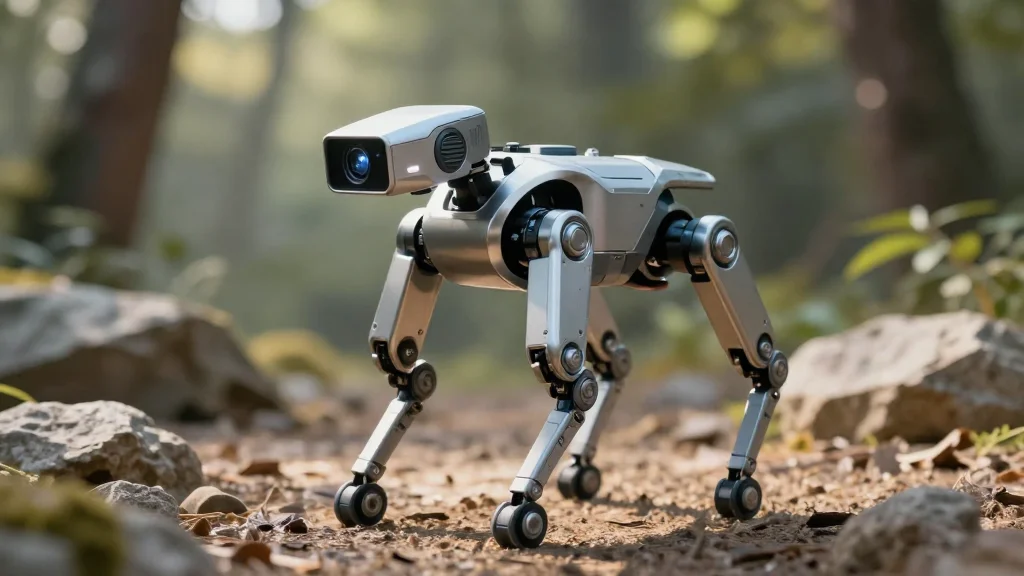
This Robot Sees Danger, Decides Its Route and Powers over Obstacles While Carrying Loads
Why It Matters
By giving legged robots true perception‑driven decision making, DreamWaQ++ expands autonomous mobility into settings where wheeled platforms fail, opening new markets for high‑risk, high‑value operations. The advance also sets a benchmark for scalable, sensor‑redundant control architectures across robotic platforms.
Key Takeaways
- •DreamWaQ++ merges camera, LiDAR with proprioception for proactive walking
- •Robot climbs 35° slopes, 1.5× lower rear‑leg torque
- •Completes 50‑step stair course in 35 seconds, beating rivals
- •Carries 2.5 kg load over 41 cm obstacles, taller than itself
- •Generalizes to higher stairs, 80% success despite limited training
Pulse Analysis
The release of DreamWaQ++ marks a pivotal shift from reactive to anticipatory locomotion in legged robotics. By integrating exteroceptive sensors—high‑resolution cameras and LiDAR—with traditional joint encoders, the system builds a real‑time terrain model that informs gait adjustments before contact. This multimodal reinforcement‑learning framework runs on lightweight hardware, automatically switching sensor modalities when data quality degrades, thereby delivering robust performance across diverse environments.
In field trials the robot demonstrated remarkable agility: it scaled a 35° incline—far steeper than its training envelope—while cutting rear‑leg motor torque by roughly one‑and‑a‑half times, and it negotiated a 50‑step stair sequence in just 35 seconds, outpacing both blind‑locomotion and commercial perception‑based controllers. Even when tasked with obstacles taller than its own chassis, the robot maintained stability while hauling a 2.5 kg payload, and simulations suggest scalability to obstacles up to 1.5 m on larger platforms like KAIST HOUND. Such capabilities are directly applicable to disaster‑site navigation, where debris and uneven ground render wheeled robots ineffective, as well as to industrial inspection of confined spaces and precision agriculture.
Looking ahead, the modular nature of DreamWaQ++ positions it for rapid adaptation to wheeled‑legged hybrids and humanoid platforms, accelerating the deployment of intelligent mobility solutions across sectors. As companies seek autonomous systems that can operate safely in unpredictable settings, the technology’s sensor‑redundancy and learning‑based decision making could become a differentiator, prompting increased investment in perception‑centric robotics and potentially reshaping standards for autonomous navigation.
This robot sees danger, decides its route and powers over obstacles while carrying loads
Comments
Want to join the conversation?
Loading comments...