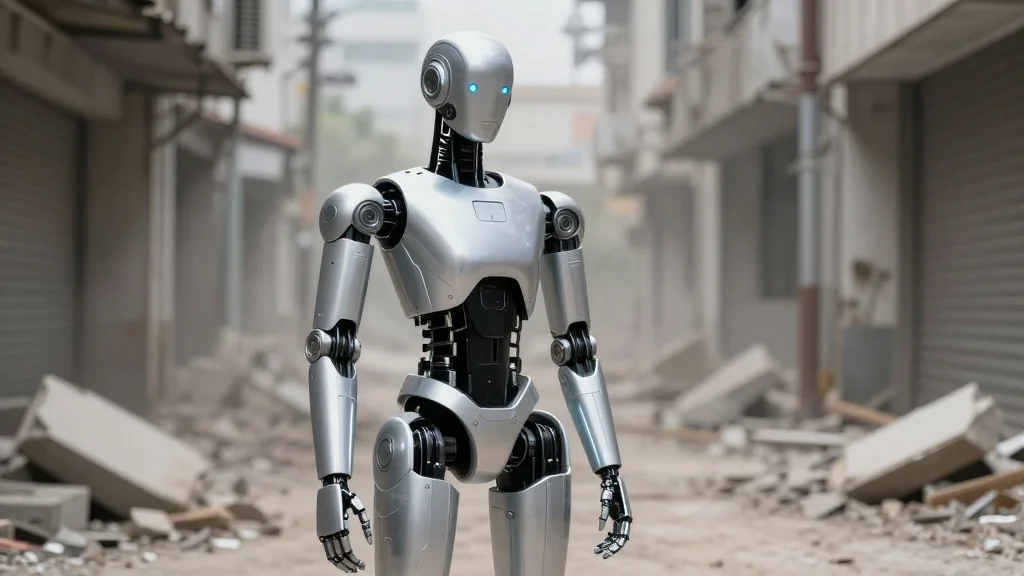
Tien Kung 3.0 Wins Inaugural Beijing Yizhuang Robot Warrior Challenge with Full Autonomy

Why It Matters
The autonomous success of Tien Kung 3.0 reshapes expectations for humanoid robots in high‑risk operations. By eliminating the need for remote operators, the technology reduces latency, communication bottlenecks and the risk of human error, all critical factors during time‑sensitive disaster response. Moreover, the competition’s public visibility accelerates stakeholder confidence, potentially unlocking funding for large‑scale deployments and encouraging other firms to prioritize full autonomy over semi‑autonomous designs. Beyond emergency services, the underlying control architecture can be repurposed for industrial inspection, nuclear decommissioning and hazardous material handling, where human presence is limited. The win therefore acts as a proof‑point that sophisticated whole‑body coordination is achievable at scale, paving the way for broader adoption of humanoid platforms across sectors that demand both mobility and manipulation in unstructured environments.
Key Takeaways
- •Tien Kung 3.0 completed the Beijing Yizhuang Robot Warrior Challenge on April 18 without any human control.
- •The robot leveraged X‑Humanoid’s “Wise KaiWu” embodied intelligence platform for closed‑loop perception, planning, control and fault recovery.
- •Challenge tasks simulated real‑world rescue scenarios, including pendulum traversal, obstacle clearance and barrier breaching.
- •Four X‑Humanoid teams and academic partners from Hunan University and Renmin University of China contributed to the effort.
- •X‑Humanoid plans field‑tests later in 2026 and is seeking partnerships with emergency management agencies.
Pulse Analysis
Tien Kung 3.0’s autonomous victory arrives at a moment when the robotics industry is pivoting from proof‑of‑concept prototypes to mission‑critical deployments. Historically, humanoid robots have excelled in controlled environments—think Boston Dynamics’ Atlas performing choreographed routines—but struggled with the unpredictability of real‑world terrain. The hierarchical control stack showcased by X‑Humanoid bridges that gap, marrying high‑level cognitive reasoning with low‑level motor execution in a way that mirrors biological motor control. This architecture could become a de‑facto standard for next‑generation service robots, especially as reinforcement learning and imitation techniques mature.
From a market perspective, the disaster‑response segment is projected to exceed $5 billion by 2030, driven by increasing frequency of natural catastrophes and stricter safety regulations. Tien Kung 3.0’s demonstration reduces a key barrier—human‑in‑the‑loop latency—making autonomous robots a more viable complement to human crews. Competitors such as Agility Robotics and PAL Robotics will likely accelerate their own autonomy roadmaps, intensifying R&D spending and potentially sparking a wave of strategic alliances with universities.
Strategically, X‑Humanoid’s collaboration with Hunan and Renmin universities not only supplies a talent pipeline but also embeds cutting‑edge academic research directly into product development. This model mirrors the successful tech transfer ecosystems seen in Silicon Valley, suggesting that China’s robotics sector could replicate that synergy on a national scale. If X‑Humanoid can translate competition success into operational contracts with emergency agencies, it may set a precedent for public‑private partnerships that fast‑track autonomous systems from the lab to the field, reshaping the economics of disaster response worldwide.
Tien Kung 3.0 Wins Inaugural Beijing Yizhuang Robot Warrior Challenge with Full Autonomy
Comments
Want to join the conversation?
Loading comments...