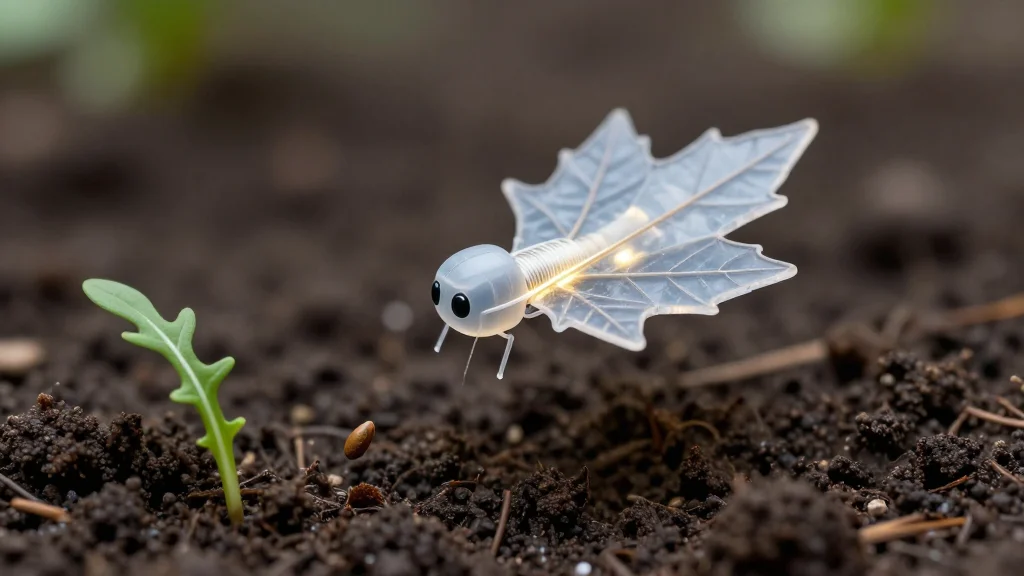
Tiny, Knotted Robots Jump, Fly and Plant Seeds
Why It Matters
The technology offers a scalable, low‑energy method for precision seeding, addressing reforestation challenges in arid regions and expanding the toolbox of soft‑robotic actuation without reliance on water or batteries.
Key Takeaways
- •Kevlar‑LCE fiber stores elastic energy, launches up to 2 m high.
- •Knot topology controls motion: flipping, spinning, multi‑stage jumps.
- •Heat‑activated release replaces rain, enabling seed planting in dry climates.
- •Leaf‑like wing adds glide or boomerang flight for precise seed placement.
- •Penetration pressure 30× greater than previous rain‑driven seed carriers.
Pulse Analysis
The breakthrough hinges on a hybrid fiber that marries Kevlar’s tensile strength with the thermally responsive nature of liquid‑crystal elastomers. By twisting and knotting the composite, researchers create a mechanical latch that holds a substantial amount of stored strain energy. When the LCE shell contracts at temperatures between 60 °C and 90 °C—readily achieved by sunlight on exposed surfaces—the knot releases, converting stored elastic energy into kinetic energy in a fraction of a second. This simple, material‑only actuation eliminates the need for onboard power sources, a long‑standing hurdle for micro‑scale robotics.
Beyond raw power, the system’s programmability stems from knot topology. An overhand knot yields a single flip, a figure‑eight induces rapid spinning, and more intricate knots untie in stages, producing choreographed aerial maneuvers. Adding a thin, maple‑leaf‑shaped wing further diversifies motion, enabling forward arcs, boomerang‑like returns, or controlled descent. These capabilities echo natural strategies—seed dispersal by samaras and insect jumping—offering designers a biologically inspired palette for soft‑robotic locomotion without electronics.
The most compelling application is autonomous seed delivery. Traditional rain‑activated seed carriers suffer from inconsistent moisture and limited penetration force. By substituting heat for water, the knotted robots generate pressures roughly thirty times higher, driving a near‑vertical entry into soil and ensuring seed‑to‑earth contact. Early trials with arugula and pine seeds demonstrated successful germination, hinting at scalable reforestation or precision agriculture solutions in hot, dry environments. Future work aims to lower activation temperatures, incorporate biodegradable materials, and integrate sensing capabilities, positioning these knot‑driven bots as a versatile platform for sustainable, low‑impact environmental interventions.
Tiny, knotted robots jump, fly and plant seeds
Comments
Want to join the conversation?
Loading comments...