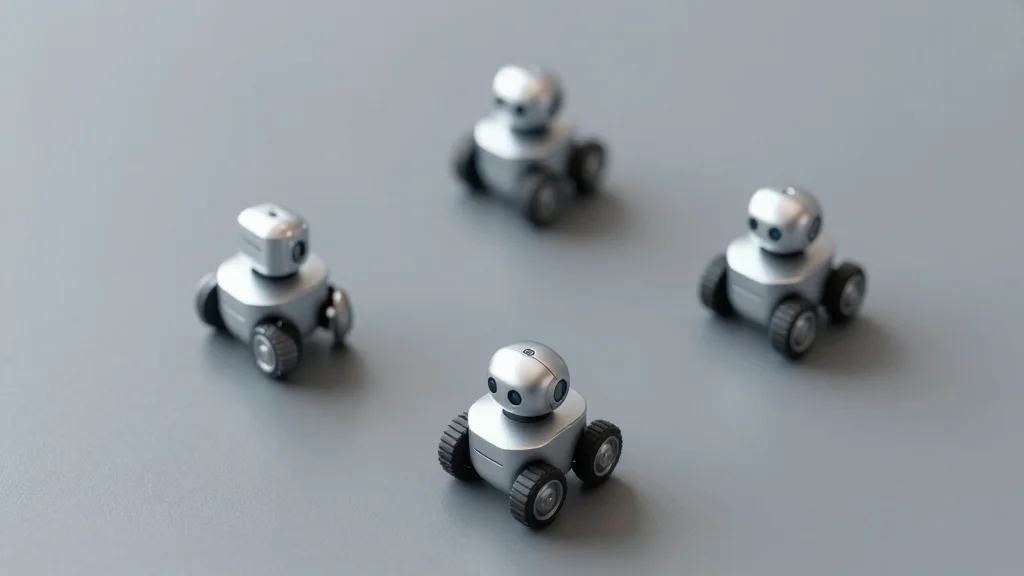
Too Many Cooks, or Too Many Robots? Finding a Goldilocks Level of Randomness to Keep Robot Swarms Moving
Why It Matters
The insight provides a low‑cost, scalable strategy for improving throughput of robot swarms and other crowded autonomous systems, directly impacting logistics, disaster response, and autonomous vehicle operations.
Key Takeaways
- •Optimal noise prevents robot traffic jams.
- •Too little randomness causes gridlock; too much wastes time.
- •Simple local rules outperform centralized control in dense swarms.
- •Formulas predict ideal robot density for given task.
- •Findings extend to crowds, logistics, and autonomous vehicles.
Pulse Analysis
The rapid deployment of autonomous robot fleets—from warehouse pickers to environmental cleanup units—has exposed a fundamental scaling problem: as more units share a confined workspace, their paths intersect and efficiency collapses. Traditional solutions rely on a central planner that computes collision‑free trajectories, but this approach becomes computationally prohibitive at high densities and vulnerable to single‑point failures. Researchers at Harvard, led by applied‑mathematician L. Mahadevan and Ph.D. student Lucy Liu, turned the problem on its head by asking whether a modest amount of randomness could actually improve flow, rather than hinder it.
The team built a suite of agent‑based simulations where each robot received a random start and destination, then moved with a tunable “wiggle” parameter. Zero wiggle produced straight‑line trajectories that quickly jammed, while excessive wiggle caused aimless wandering and low throughput. By sweeping the noise level, they identified a narrow Goldilocks zone in which brief, self‑resolved jams allowed robots to slip past one another, maximizing the goal‑attainment rate. Analytical formulas derived from these experiments linked optimal noise to crowd density, offering a closed‑form rule that predicts how many units can operate efficiently in a given area.
Beyond the laboratory, the findings promise immediate value for logistics operators, disaster‑response teams, and autonomous‑vehicle designers who must orchestrate dense fleets without relying on heavyweight central servers. Implementing a calibrated noise component—whether through slight heading perturbations or stochastic task reassignment—can be achieved in firmware with negligible computational overhead. Moreover, the study reinforces a broader principle of active‑matter physics: complex collective behavior often emerges from simple, locally enforced rules. As industries push toward ever larger swarms, embracing controlled randomness may become the standard engineering lever for maintaining throughput while avoiding costly congestion.
Too many cooks, or too many robots? Finding a Goldilocks level of randomness to keep robot swarms moving
Comments
Want to join the conversation?
Loading comments...