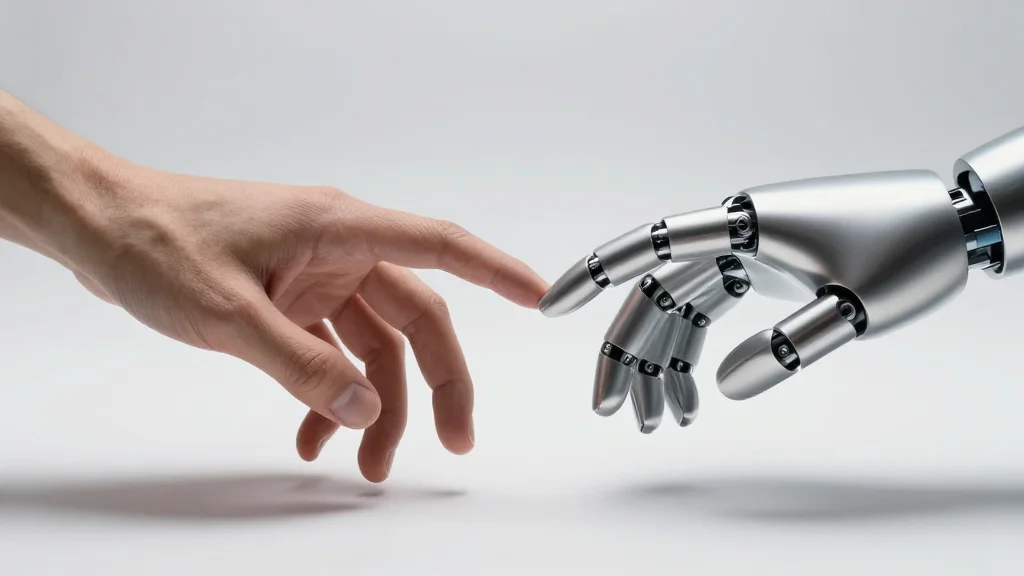
'Touch Dreaming' Helps Humanoid Robots Handle Five Tricky Tasks with 90.9% Higher Success
Why It Matters
Touch‑aware learning dramatically raises humanoid robots' reliability in contact‑intensive tasks, accelerating their adoption in homes, factories, and service settings.
Key Takeaways
- •HTD predicts tactile latent signals, not raw sensor data.
- •Separate lower-body controller maintains balance during complex hand tasks.
- •Touch dreaming yields 90.9% relative success boost over ACT baseline.
- •Open-source code enables broader research and cross‑robot adaptation.
Pulse Analysis
Humanoid robots have long struggled to match human dexterity because most control pipelines rely heavily on vision and proprioception, neglecting the rapid, nuanced feedback that touch provides. The new HTD framework tackles this gap by embedding tactile prediction directly into the policy network, allowing the robot to anticipate how forces will evolve during manipulation. This predictive touch capability, dubbed "touch dreaming," creates a richer internal model of contact dynamics, enabling smoother, safer interactions with fragile or irregular objects.
The technical novelty lies in HTD's dual‑layer architecture: a reinforcement‑learning‑based lower‑body controller ensures stable locomotion, while an upper‑body inverse‑kinematics module and hand‑retargeting system handle precise pose tracking. Crucially, the system learns compact tactile latent representations instead of raw sensor streams, reducing noise and computational load. Experiments show a 30% gain when predicting latent tactile signals versus raw data, and a striking 90.9% relative improvement in task success compared with the ACT baseline across five diverse, contact‑rich scenarios.
From a market perspective, this breakthrough lowers a major barrier to deploying humanoid robots in real‑world environments such as households, retail, and manufacturing. By delivering reliable whole‑body manipulation without sacrificing balance, HTD makes service robots viable for tasks like laundry handling, inventory organization, and patient assistance. The open‑source release invites industry and academia to adapt the framework to different robot morphologies, accelerating the creation of scalable, embodiment‑agnostic manipulation systems that could soon become a staple in automated workforces.
'Touch dreaming' helps humanoid robots handle five tricky tasks with 90.9% higher success
Comments
Want to join the conversation?
Loading comments...