Training Four-Legged Robots as if They Were Dogs
•January 31, 2026
0
Companies Mentioned

Why It Matters
By allowing non‑expert users to impart new abilities quickly, the method accelerates the deployment of agile legged robots in homes, workplaces and public spaces.
Key Takeaways
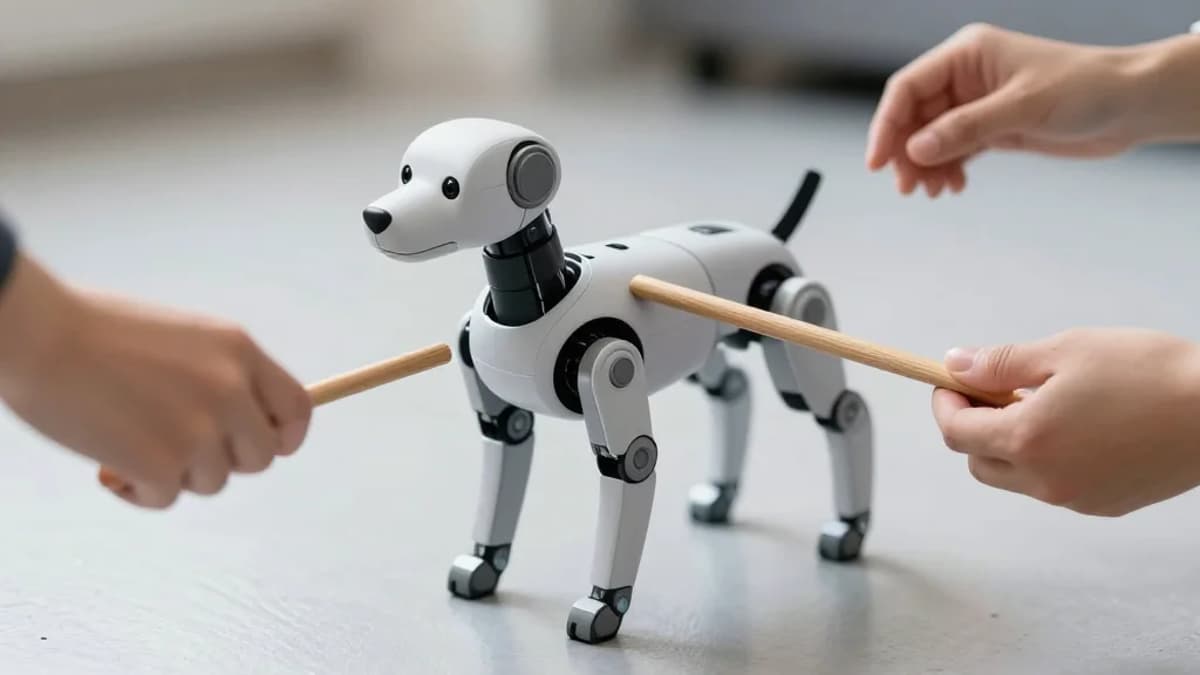
- •Training rod guides robot like dog leash
- •97.15% success on navigation tasks
- •Few real interactions needed, then simulate
- •Gestures and speech replace hardware rewards
- •Framework extensible to manipulation and humanoid robots
Pulse Analysis
Legged robots have long been hailed for their ability to traverse uneven terrain, yet their real‑world adoption stalls because they rely on extensive simulated training and expert‑level programming. Traditional pipelines demand thousands of hours of data collection, limiting flexibility and inflating development costs. As autonomous systems move from factories into everyday environments, the industry seeks methods that blend adaptability with data efficiency, mirroring how biological agents learn through direct interaction.
The newly proposed dog‑training paradigm borrows from canine pedagogy, replacing treats with a physical training rod that physically lures the robot along desired paths. Human operators can then reinforce behaviors with natural gestures and voice commands, allowing the robot to internalize tasks after only a handful of real‑world demonstrations. A scene‑reconstruction module mirrors these interactions in a virtual sandbox, letting the robot rehearse and refine motions without further human input. Early experiments on a quadruped platform demonstrated rapid mastery of obstacle‑avoidance, following, and jumping, achieving a 97.15% success rate—significantly higher than baseline reinforcement approaches.
Beyond immediate performance gains, this framework reshapes the business case for legged robots. By lowering the expertise barrier, manufacturers can market robots that end‑users customize on‑the‑fly, opening new revenue streams in consumer robotics, logistics, and field services. Future extensions to loco‑manipulation and humanoid platforms could enable robots to learn complex, whole‑body tasks such as tool handling or collaborative assembly, further blurring the line between programmed automation and intuitive, human‑centric interaction. The convergence of animal‑inspired teaching and simulation‑augmented learning may become a cornerstone of next‑generation robotic ecosystems.
Training four-legged robots as if they were dogs
0
Comments
Want to join the conversation?
Loading comments...