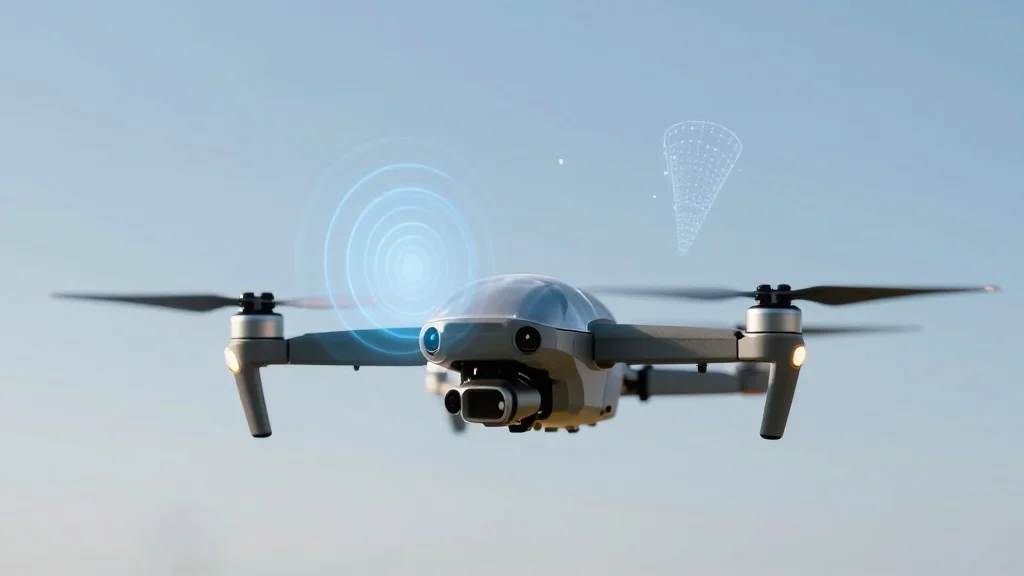
Ultralightweight Sonar Plus AI Lets Tiny Drones Navigate Like Bats
Why It Matters
The technology makes micro‑drones viable for time‑critical search‑and‑rescue, poaching deterrence, and cave exploration where traditional sensors fail. Its low‑cost, low‑power profile could accelerate deployment of drone swarms in disaster zones.
Key Takeaways
- •Ultrasound sonar with AI enables drones to navigate in darkness
- •Acoustic shield cuts propeller noise, improving echo detection
- •Neural net Saranga extracts weak echoes from noisy measurements
- •System reduces power, weight, and cost dramatically versus lidar
- •Enables swarms for search‑and‑rescue, anti‑poaching, and cave exploration
Pulse Analysis
Traditional aerial robots rely on cameras, lidar or radar to perceive their surroundings, but each of these modalities struggles when visibility drops due to smoke, fog, dust, or total darkness. Cameras need light, lidar’s laser beams scatter, and radar demands power levels unsuitable for gram‑scale platforms. This gap has spurred interest in bio‑inspired solutions that mimic the echolocation abilities of bats, which can resolve obstacles as fine as a human hair while weighing less than two paper clips.
The WPI team’s breakthrough combines two innovations: a lightweight acoustic shield that isolates the sonar transducers from the roar of propellers, and Saranga, a deep‑learning model trained to tease out faint echo signatures from noisy data. The shield, modeled after bat ear cartilage, attenuates propeller‑generated sound, while Saranga learns the statistical patterns of genuine echoes, delivering reliable 3‑D obstacle maps with only milliwatts of power. Compared with conventional camera‑lidar stacks, the new system slashes power draw by roughly a thousandfold, trims weight by a factor of ten, and cuts component cost by about a hundred times, making it practical for sub‑100‑gram drones.
The implications extend far beyond academic curiosity. Low‑cost, ultra‑light drones equipped with AI‑enhanced sonar could be deployed in swarms to scour burning forests, collapsed structures, or subterranean caves where human entry is unsafe. Their ability to operate in any lighting condition also opens avenues for wildlife monitoring, anti‑poaching patrols, and environmental sensing in remote or polluted airspaces. As the technology matures, manufacturers are likely to integrate hybrid sensor suites—combining sonar, infrared and minimal visual cues—to create resilient platforms that keep critical missions moving when traditional optics fail.
Ultralightweight sonar plus AI lets tiny drones navigate like bats
Comments
Want to join the conversation?
Loading comments...