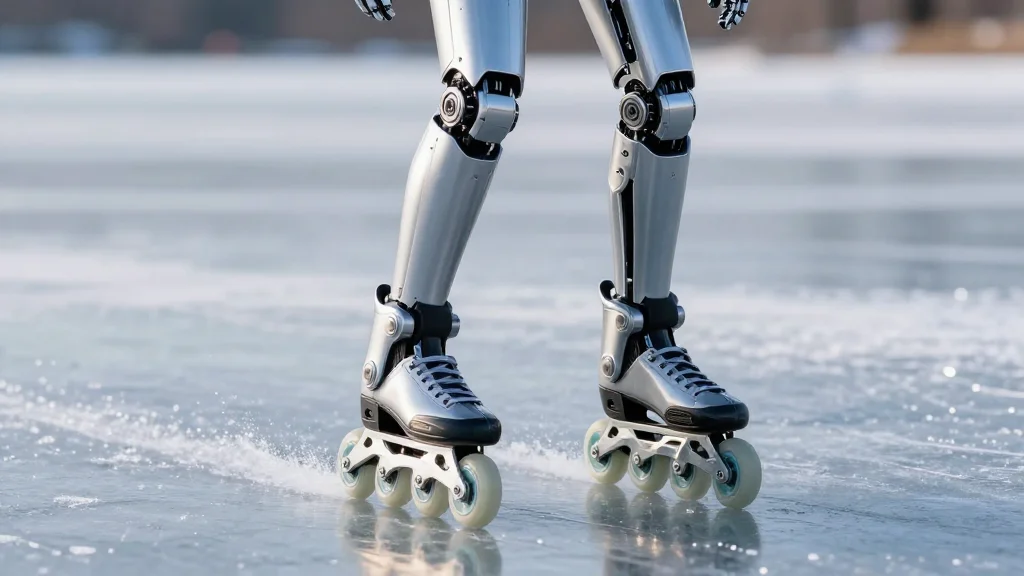
Unitree Robotics' G1 Humanoid Glides on Ice and Rollerblades, Showcasing New Balance Tech

Companies Mentioned

Why It Matters
The G1’s ice‑skating and rollerblading feats illustrate a tangible leap in dynamic balance for humanoid robots, a long‑standing hurdle that has limited their deployment outside controlled labs. By proving that a robot can maintain stability while performing high‑speed, low‑friction maneuvers, Unitree opens the door to applications ranging from indoor logistics to entertainment and public safety, where rapid, adaptable movement is essential. Beyond the spectacle, the release of a large‑scale motion dataset signals a shift toward open, data‑driven development in embodied AI. Researchers and startups worldwide can now train models on real‑world full‑body motion, accelerating innovation and potentially democratizing access to advanced robotics technology. This could compress the timeline for achieving truly autonomous, versatile humanoid assistants, reshaping labor markets and consumer expectations.
Key Takeaways
- •Unitree Robotics' G1 humanoid robot performed ice skating and rollerblading, executing spins and flips without pausing.
- •The G1 combines a wheeled base (≈1 m/s) with 19 degrees of freedom, powered by an NVIDIA Jetson Orin NX (up to 100 TOPS).
- •CEO Wang Xingxing highlighted data scarcity as a bottleneck and announced an open‑source full‑body motion dataset.
- •Hybrid wheel‑leg design challenges pure‑legged competitors like Boston Dynamics, promising faster traversal on flat surfaces.
- •The demo aligns with China's 15th Five‑Year Plan focus on AI‑plus initiatives and large‑scale embodied‑intelligence data collection.
Pulse Analysis
Unitree’s G1 demonstration is more than a publicity stunt; it signals a strategic inflection point in humanoid robotics. Historically, the field has been split between wheeled platforms that excel in speed but falter on uneven ground, and legged bots that navigate complex terrain at the cost of energy efficiency and agility. By integrating wheels into a humanoid frame, Unitree effectively creates a dual‑mode locomotion system that can switch on the fly, a capability that could redefine operational economics for service robots. The real‑time balance control showcased on ice—a surface that eliminates friction cues—demonstrates that the underlying control algorithms have matured to a level where sensor fusion and predictive modeling can compensate for extreme environmental variables.
The broader market impact hinges on the open‑source motion dataset. Data has been the missing link for scaling embodied AI; without large, high‑quality motion libraries, learning‑by‑simulation remains brittle. Unitree’s decision to share its dataset could catalyze a wave of third‑party innovations, much like ImageNet did for computer vision. Startups may now train specialized manipulation or navigation models without the prohibitive cost of collecting their own data, accelerating product cycles and fostering competition. This democratization may also pressure incumbents to open their own datasets or risk being outpaced.
Looking forward, the G1’s next challenge will be translating controlled‑environment performance into robust field deployments. Real‑world logistics, retail assistance, and public‑space interaction demand not only balance but also reliable perception under variable lighting, crowds, and obstacles. If Unitree can demonstrate sustained operation in such settings, it will likely attract significant commercial contracts, especially as Chinese policy continues to subsidize AI‑plus initiatives. The convergence of hybrid locomotion, high‑performance edge computing, and open data could thus accelerate the timeline for humanoid robots moving from novelty to utility within the next three to five years.
Unitree Robotics' G1 Humanoid Glides on Ice and Rollerblades, Showcasing New Balance Tech
Comments
Want to join the conversation?
Loading comments...