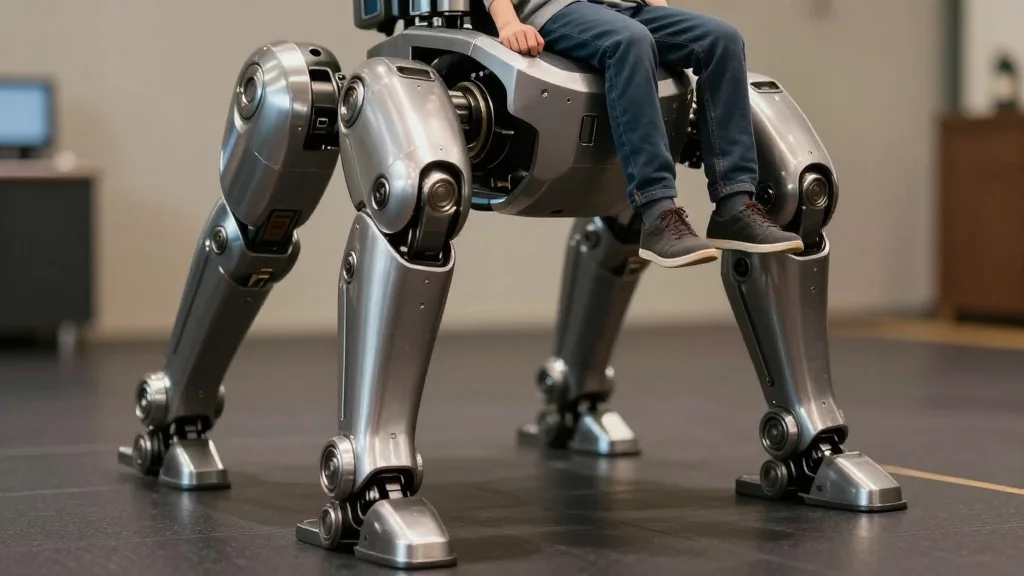
Unitree Unveils $574,000 GD01 Rideable Robot That Walks on Two Legs

Companies Mentioned
Why It Matters
The GD01 illustrates how robotics is crossing the threshold from small, indoor devices to large, human‑scale machines capable of carrying passengers. Its dual‑mode locomotion hints at future robots that can adapt to varied terrains, expanding the scope of autonomous mobility in sectors like disaster response and industrial inspection. Moreover, the high price tag and regulatory uncertainties underscore the challenges of commercializing such platforms, highlighting the need for standards that can keep pace with rapid hardware innovation. If Unitree’s broader ecosystem—app stores, lower‑cost humanoids, and a forthcoming $610 million capital raise—delivers a sustainable pipeline of software and hardware, the GD01 could become a flagship demonstration of a new revenue model: selling not just robots, but the digital skills that make them versatile. This could reshape how investors evaluate robotics firms, shifting focus from unit sales to ecosystem value.
Key Takeaways
- •Unitree unveiled the GD01, a rideable robot priced at $574,000.
- •The robot weighs about 1,100 lb with a passenger and can switch between bipedal and quadrupedal modes.
- •Unitree is preparing a $610 million STAR Market listing to fund AI research and manufacturing.
- •Potential applications include entertainment, research, security demos, and specialized industrial testing.
- •Regulatory frameworks will need to evolve to address safety and legal use of large, passenger‑bearing robots.
Pulse Analysis
Unitree’s GD01 is less a product launch than a strategic signal. By investing $574,000 in a single unit, the company is betting that the market for high‑visibility, human‑scale robots will expand faster than the technology’s cost curve can be reduced. The move mirrors a pattern seen in electric vehicles, where early adopters pay premium prices while manufacturers iterate toward broader affordability. If Unitree can leverage its UniStore platform to monetize software extensions—dance routines, obstacle‑avoidance algorithms, or mission‑specific payloads—it may offset the hardware’s high price and create recurring revenue streams.
Historically, Chinese robotics firms have excelled at low‑cost manufacturing but lagged in embodied AI. The planned $610 million capital raise is a clear attempt to bridge that gap, funding research that could enable more sophisticated perception and decision‑making on platforms like the GD01. Success would position Unitree alongside a small cohort of global players—Boston Dynamics, Agility Robotics—who are already field‑testing bipedal robots for logistics and delivery. However, the GD01’s current lack of disclosed performance metrics (range, speed, safety systems) leaves investors and regulators with unanswered questions that could slow adoption.
The broader implication for the robotics sector is the emergence of a new product tier: large, rideable machines that blend vehicle dynamics with humanoid locomotion. This tier could unlock niche markets—theme‑park attractions, high‑profile exhibitions, and specialized industrial testing—while serving as a testbed for technologies that will eventually trickle down to more affordable, utility‑focused robots. The GD01 thus acts as both a showcase and a catalyst, prompting competitors to accelerate development of transformable locomotion and prompting policymakers to consider safety standards for human‑carrying robots. The next few quarters will reveal whether Unitree can translate this headline‑grabbing prototype into a sustainable business line or if it remains a spectacular, but isolated, demonstration.
Unitree Unveils $574,000 GD01 Rideable Robot That Walks on Two Legs
Comments
Want to join the conversation?
Loading comments...