Companies Mentioned
Why It Matters
The technology makes large‑scale robotic grinding economically viable, unlocking automation for sectors that previously relied on manual, costly processes.
Key Takeaways
- •Güdel's TMV/TMF lets one robot grind surfaces previously needing multiple units
- •Capital costs drop as single robot replaces several fixed‑robot cells
- •Process stability improves by keeping robot in optimal posture during grinding
- •System tolerates abrasive environments, extending uptime in harsh grinding zones
- •FANUC R‑1000 integration shows scalability for heavy‑duty grinding tasks
Pulse Analysis
Robotic grinding has long been a textbook example of the DDD (dull, dirty, dangerous) problem that automation promises to solve, yet scaling the process to large, irregular parts has remained elusive. Traditional cells rely on fixed‑position robots, forcing manufacturers to split work across several units or repeatedly re‑fixture components. Both approaches inflate capital spend, increase cycle time, and introduce variability that erodes part quality. By adding two degrees of freedom—vertical lift and horizontal track motion—Güdel’s system redefines the workspace envelope, allowing a single high‑performance robot to traverse massive surfaces while preserving consistent contact force.
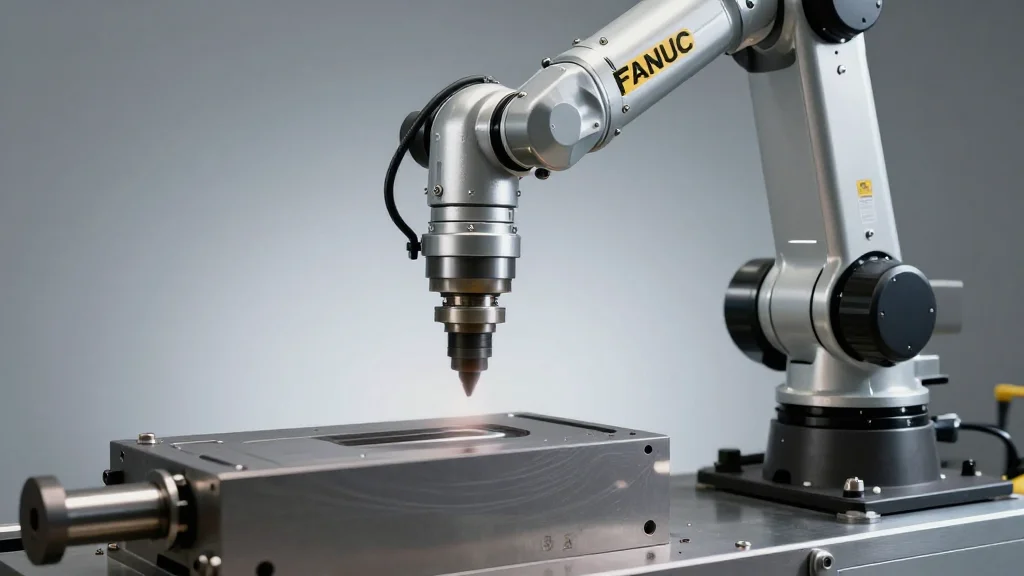
The core of Güdel’s offering lies in its TrackMotion Vertical™ and TrackMotion Floor™ modules, which integrate seamlessly with existing robot platforms such as FANUC’s R‑1000. In the Automate demo, the robot was mounted on a vertical lift that raised the tool into the grinding zone, then slid along a floor‑mounted gantry to cover the entire part length. This configuration keeps the robot’s joints within optimal ranges, reducing wear and extending service life, while the track’s sealed design shields critical components from abrasive debris. The result is a stable, repeatable grinding process that can be fine‑tuned via software, eliminating costly mechanical redesigns as product geometries evolve.
For manufacturers in automotive, aerospace, heavy‑industrial, and off‑road equipment markets, the implications are significant. Lower upfront investment and higher equipment utilization translate into faster ROI, while the enhanced stability improves surface finish consistency—critical for performance‑critical parts. As OEMs push for greater automation to meet labor shortages and sustainability goals, solutions like Güdel’s multi‑axis motion system are poised to become a new standard for large‑scale grinding, potentially reshaping supply‑chain dynamics and accelerating the shift toward fully automated production lines.
Untitled
Comments
Want to join the conversation?
Loading comments...