Why It Matters
Persistent, vehicle‑mounted ISR reduces crew exposure and shortens the decision cycle in contested environments, while the open architecture positions Black Recon for rapid adoption across defense and public‑safety markets.
Key Takeaways
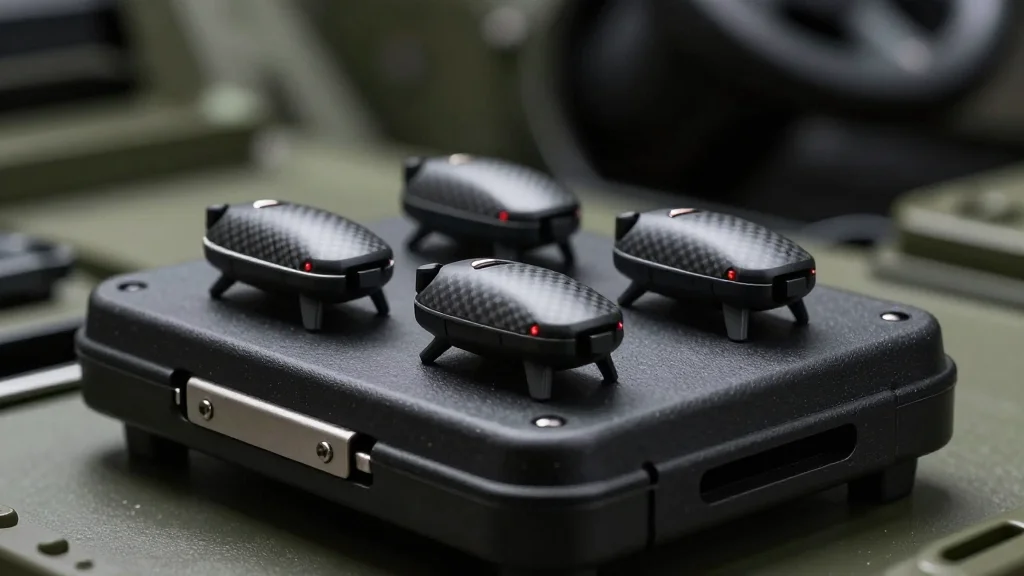
- •Black Recon launches, recovers, recharges three UAVs autonomously from a vehicle.
- •50‑60 minute flight time and 25 m/s speed extend ISR reach.
- •Operates in GNSS‑denied environments using visual‑inertial navigation.
- •Weighs under 450 g, enabling low‑SWaP integration on ground platforms.
- •Modular design supports future lethal, CBRN, and public‑safety payloads.
Pulse Analysis
The rise of autonomous micro‑drones reflects a broader shift toward distributed, on‑demand intelligence on the battlefield. Traditional UAVs require external launch crews and ground control stations, limiting responsiveness in high‑tempo operations. Black Recon’s self‑contained launch, capture and recharge cycle eliminates that bottleneck, allowing armored vehicles or static outposts to field persistent surveillance without exposing personnel. This capability aligns with NATO’s push for “sensor‑to‑shooter” loops, where data is captured, processed and acted upon within minutes.
Technically, Black Recon leverages Teledyne’s heritage in thermal imaging and visual‑inertial navigation to operate in GPS‑jammed or spoofed environments while remaining radio‑silent. Each sub‑450‑gram UAV can stay aloft for up to an hour, cruising at 25 m/s, and the three‑drone rotation ensures continuous coverage. The system’s onboard relay extends radio range, and compatibility with the Black Hornet 4 nano‑drone adds a layered ISR capability. Such performance metrics position the platform as a force multiplier for ground units that need rapid target acquisition and threat detection without relying on external air support.
Beyond pure combat, Black Recon’s modular mission‑module architecture opens doors to civilian applications such as border patrol, critical‑infrastructure monitoring, and first‑responder situational awareness. By offering plug‑and‑play payloads for CBRN detection or future lethality, Teledyne creates a versatile product line that can evolve with emerging threats. With deliveries slated for 2027, the system is poised to capture market share in both defense and public‑safety sectors, reinforcing Teledyne’s position as a leading provider of integrated, low‑SWaP sensing solutions.
Untitled
Comments
Want to join the conversation?
Loading comments...