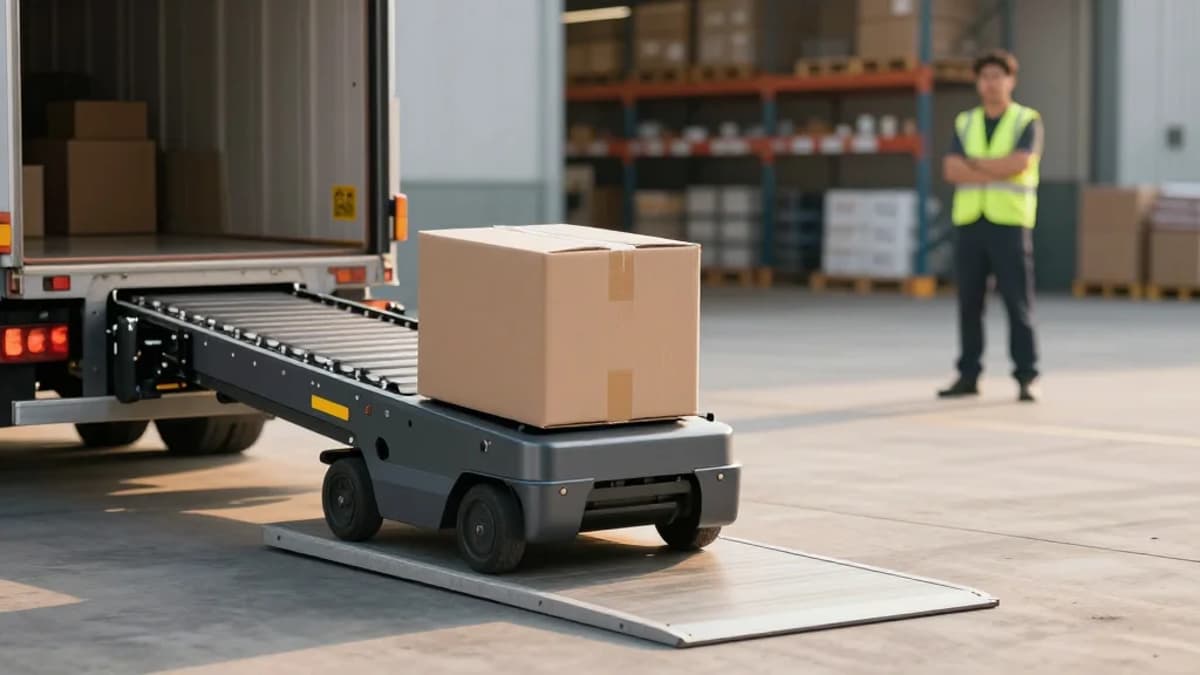
UPS Buys Hundreds of Robots to Unload Trucks in Automation Push
•December 16, 2025
0
Companies Mentioned


Why It Matters
The move accelerates UPS’s shift away from labor‑intensive dock work, targeting $3 billion in cost savings by 2028 and strengthening its competitive stance against highly automated rivals like Amazon.
Key Takeaways
- •UPS invests $120M for 400 Pickle robots.
- •Robots unload a truck in roughly two hours.
- •Payback period about 18 months via labor savings.
- •Robots work in existing warehouses, no facility upgrades.
- •Automation aims to save $3B by 2028.
Pulse Analysis
UPS’s latest robot purchase underscores a decisive pivot toward large‑scale automation in a sector still dominated by manual dock labor. The $120 million investment in Pickle Robot’s mobile arms dovetails with the company’s $9 billion, four‑year plan to modernize over 60 facilities. By targeting the bottleneck of truck unloading, UPS hopes to reduce the labor intensity that has long constrained profit margins, especially as it trims low‑margin e‑commerce volumes tied to Amazon. This strategic focus mirrors broader industry trends where carriers are reconfiguring networks to improve efficiency and resilience.
Pickle Robot’s technology differentiates itself by fitting into existing warehouse layouts without extensive retrofitting. The AI‑driven arm can navigate shipping containers, lift items up to 50 pounds with suction, and place them on conveyors, completing a typical truck unload in about two hours. With a projected 18‑month ROI, the solution offers a clear financial case for operators seeking to replace repetitive, physically demanding tasks. UPS plans to roll out the units throughout the second half of 2026, using pilot data to guide further purchases, a method that balances innovation risk with operational continuity.
The broader robotics market is heating up, with venture capital slated to exceed $12.5 billion in 2025, reflecting heightened investor confidence in warehouse automation. Competitors such as Boston Dynamics’ Stretch robot and Amazon’s legacy Kiva systems illustrate a crowded field vying for early‑stage logistics niches. UPS’s commitment signals to the industry that dock‑side automation is the next frontier, potentially reshaping labor dynamics and cost structures across the supply chain. As more carriers adopt similar solutions, the competitive pressure on labor costs and service speed will intensify, driving further investment in AI‑enabled robotics.
UPS buys hundreds of robots to unload trucks in automation push
0
Comments
Want to join the conversation?
Loading comments...