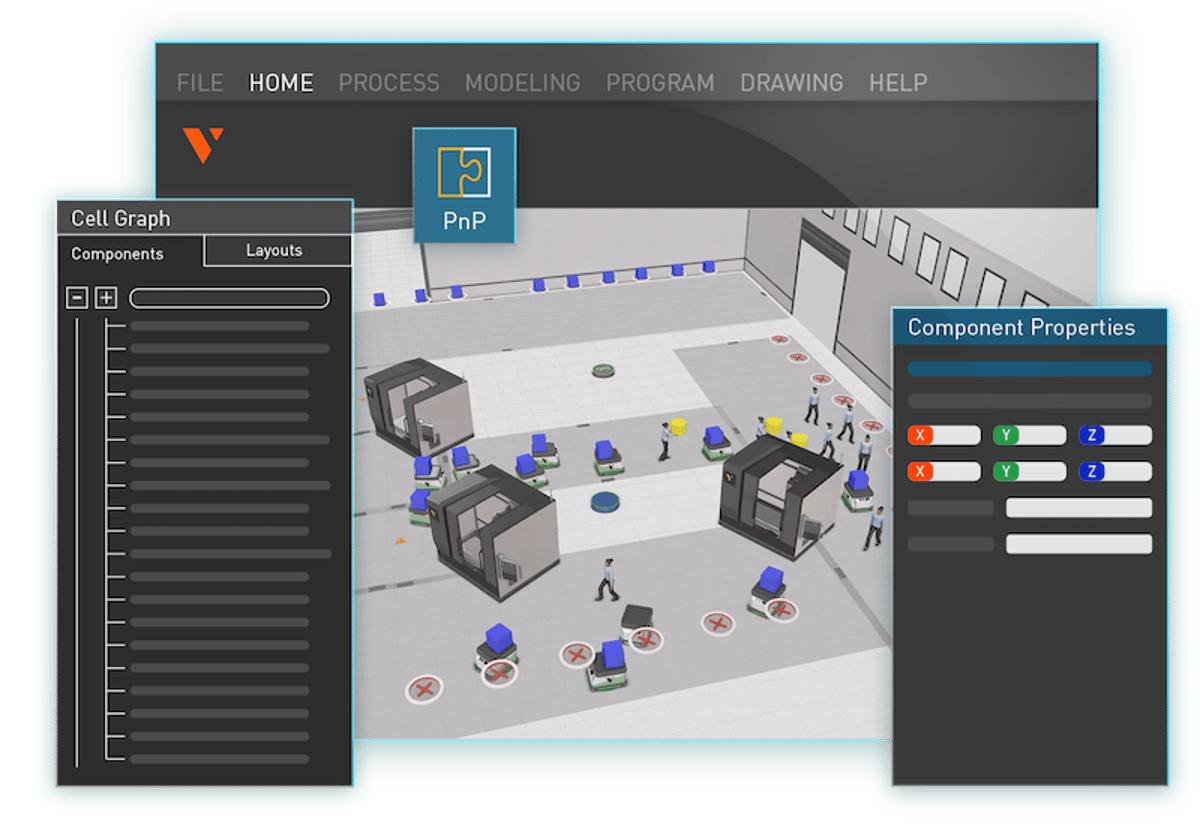
Visual Components Launches New Version of Its Factory Simulation Software
Companies Mentioned
Why It Matters
By enabling realistic, large‑scale simulation of entire production lines, Visual Components 5.1 helps manufacturers cut time‑to‑production and avoid expensive on‑site errors, a critical advantage as factories become more autonomous and complex.
Key Takeaways
- •5.1 runs hundreds of AMRs and AGVs in one simulation
- •Performance up to 10× faster than previous version
- •Adds Allen‑Bradley PLC support and new robot plugins
- •Python 3 replaces legacy scripting environment
- •Validates control logic and layout before floor deployment
Pulse Analysis
The rise of autonomous mobile robots, collaborative arms and connected equipment is reshaping modern factories, but it also introduces intricate interaction challenges. Traditional validation methods—often manual or limited to isolated subsystems—can miss emergent bottlenecks or safety hazards. Visual Components' new 5.1 platform tackles this gap by delivering a physics‑accurate, full‑scale digital twin that mirrors real‑world dynamics, allowing engineers to test thousands of moving assets simultaneously without physical prototypes.
Version 5.1’s technical upgrades are designed for speed and integration. A ten‑fold performance boost makes large‑scale scenarios practical, while support for Allen‑Bradley PLCs and virtual‑commissioning plugins for Nachi and Epson robots pulls actual controller logic into the simulation loop early in the project lifecycle. The shift to Python 3 modernizes the scripting environment, giving developers a familiar, extensible language to craft complex robot programs and automation scripts. Together, these features streamline the validation workflow, reduce iteration cycles, and foster cross‑functional collaboration between engineering, operations and management teams.
For industries such as automotive, electronics, logistics and healthcare—where production lines must adapt quickly to product variations and supply‑chain volatility—the ability to pre‑emptively identify traffic jams, collision risks or layout inefficiencies translates directly into cost savings and faster market entry. By providing a comprehensive, data‑driven view of the entire factory floor, Visual Components 5.1 positions itself as a strategic tool for manufacturers seeking to de‑risk capital investments and accelerate the rollout of next‑generation autonomous production systems.
Visual Components launches new version of its factory simulation software
Comments
Want to join the conversation?
Loading comments...