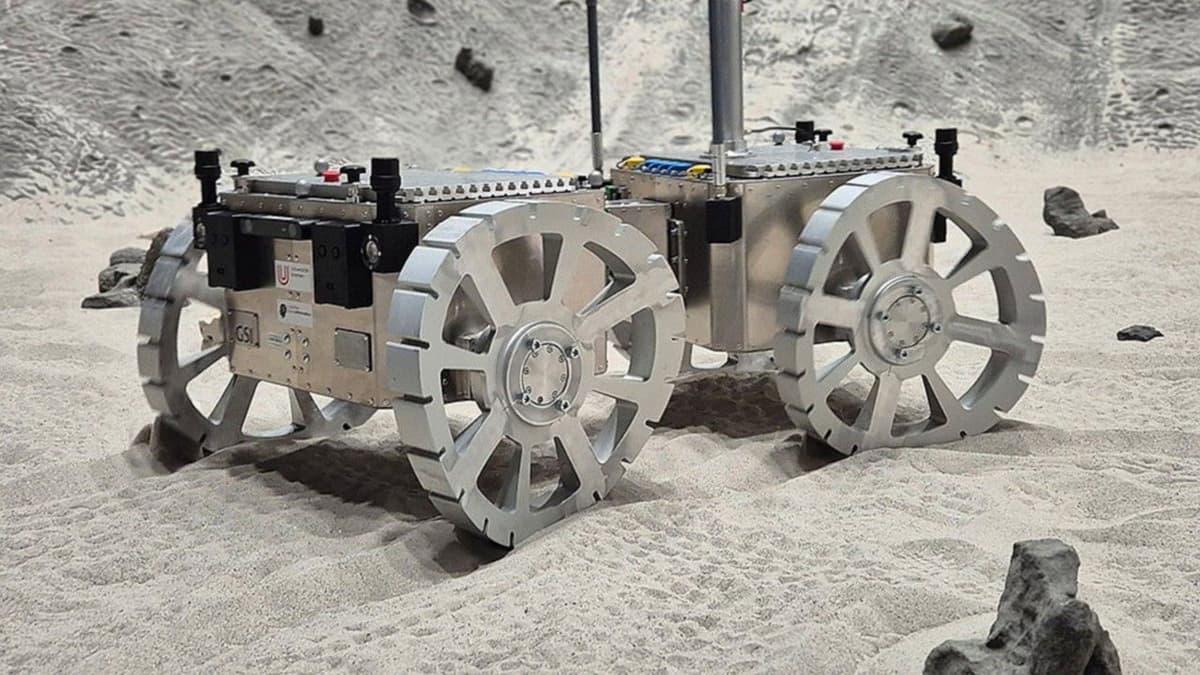
Watch This Bio-Inspired Mars Rover Concept 'Swim' Through Sand on Curved Wheels (Video)
Companies Mentioned
Why It Matters
If successful, the technology could dramatically extend the range and reliability of future Mars surface missions, reducing the risk of wheel‑sink failures in sandy environments. It also provides a scalable model for swarm‑based exploration of complex terrains, accelerating scientific return on costly interplanetary projects.
Key Takeaways
- •Curved wheels mimic sandfish lizard, enabling “swimming” locomotion on sand
- •VaMEx aims to create autonomous robot swarms for Valles Marineris exploration
- •Tests show stable movement but highlight need for slippage control algorithms
- •Bio‑inspired mobility could improve future crewed and robotic Mars missions
Pulse Analysis
Bio‑inspired robotics has long promised to bridge the gap between natural adaptation and engineered performance. By copying the sandfish lizard’s ability to generate sinusoidal body waves, the VaMEx team created wheels that generate both longitudinal and lateral forces, allowing a four‑wheeled platform to glide through fine Martian regolith without the typical sinkage that plagues conventional rovers. This approach reduces energy consumption and wear, key considerations for missions where power is limited and maintenance is impossible. The underlying physics—leveraging shape‑induced fluidization of granular media—offers a fresh design paradigm for future planetary mobility systems.
The Valles Marineris Explorer project envisions a heterogeneous swarm of rovers, crawlers, and drones working in concert to map the canyon’s hidden niches. The curved‑wheel rover serves as a mobility workhorse, complementing walking and aerial units that can negotiate steep cliffs or overhangs. Integrating these modalities requires sophisticated autonomy, from terrain classification to real‑time path planning, and the VaMEx team is already testing software that accounts for slippage, sinking, and wheel‑terrain interaction. Such multi‑modal swarms could dramatically increase coverage rates, turning a months‑long campaign into weeks while delivering higher‑resolution data.
The implications extend beyond scientific curiosity. Reliable sand‑traversing rovers lower the logistical risk for crewed missions that will need to transport equipment across dusty plains and dune fields. Commercial entities eyeing in‑situ resource utilization stand to benefit from platforms that can reach and sample volatile‑rich deposits without becoming immobilized. As NASA, ESA, and private partners plan the next wave of Mars exploration, bio‑inspired mobility solutions like VaMEx’s curved wheels could become a standard component in the toolkit for conquering the Red Planet’s most challenging terrains.
Watch this bio-inspired Mars rover concept 'swim' through sand on curved wheels (video)
Comments
Want to join the conversation?
Loading comments...