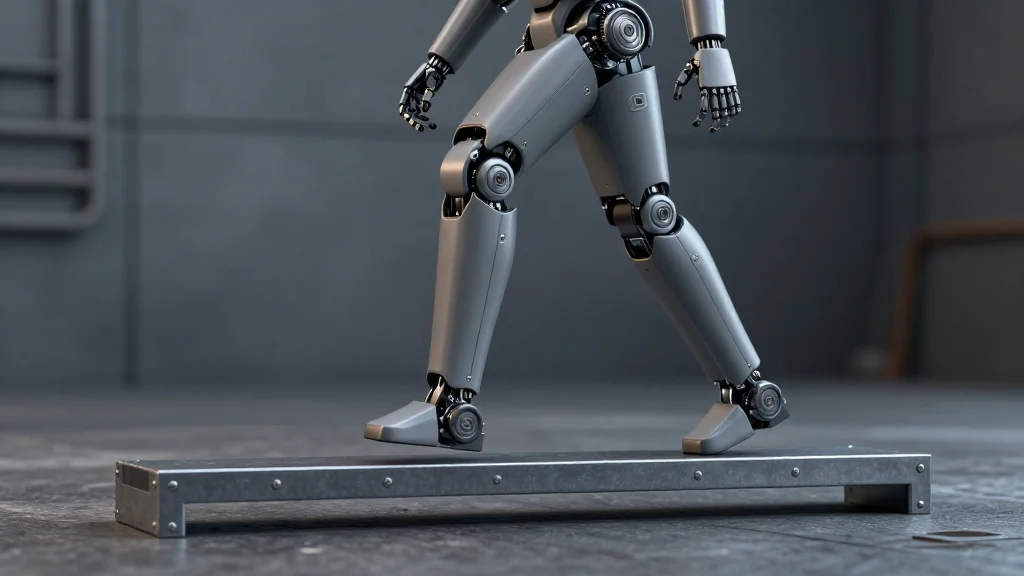
X-Humanoid's Embodied Tien Kung 3.0 Wins Beijing Robot Warrior Challenge with Fully Autonomous Run
Why It Matters
The achievement demonstrates that full‑size humanoid robots can reliably operate autonomously in hazardous settings, accelerating their adoption for emergency response and industrial tasks. It signals a transition from experimental prototypes to deployable embodied‑intelligence solutions.
Key Takeaways
- •Embodied Tien Kung 3.0 won fully autonomous Robot Warrior Challenge
- •First full‑size humanoid to outscore smaller robots in disaster course
- •Wise KaiWu platform integrates perception, planning, control without human input
- •Open interfaces let university teams generate scalable rescue‑scenario data
- •Breakthrough enables autonomous robots for emergency response and industry
Pulse Analysis
The Beijing Yizhuang Robot Warrior Challenge, staged on April 18, served as a proving ground for next‑generation disaster‑response robotics. X‑Humanoid entered its full‑size general‑purpose platform, Embodied Tien Kung 3.0, and completed every obstacle—pendulum traversal, barrier breaching, and obstacle clearance—without any remote assistance. By securing the highest overall score and the Warrior Intelligent Mobility Award, the robot became the first fully autonomous champion in a field historically dominated by smaller, semi‑controlled machines. The win underscores a tangible shift from laboratory locomotion demos to operational competence in unstructured, high‑risk environments and set a new benchmark for autonomous robotics.
At the heart of the performance lies X‑Humanoid’s proprietary ‘Wise KaiWu’ embodied‑intelligence platform. The system fuses a hierarchical control architecture with multimodal terrain perception, allowing centimeter‑level environmental models to be generated in milliseconds. High‑level decision‑making feeds directly into a low‑latency motion layer that optimizes foot placement and global path planning on a step‑by‑step basis. Reinforcement‑learning‑driven full‑body control delivers smooth stand‑walk‑run transitions even when the robot is struck or encounters sudden disturbances, effectively closing the perception‑to‑action loop without human oversight. This integration also reduces the sim‑to‑real gap dramatically.
The victory has immediate commercial ramifications. By exposing university partners to open hardware and software interfaces, X‑Humanoid accelerates the creation of validation data for post‑earthquake rescue, chemical‑hazard mitigation, and firefighting operations. Enterprises seeking autonomous logistics or manufacturing assistants now have a demonstrable, scalable platform that can navigate cluttered, dynamic spaces without teleoperation. Investors are likely to view the achievement as proof that embodied intelligence can move beyond pilot projects, prompting increased funding for full‑size humanoid deployments across public safety and heavy‑industry sectors. Such momentum could reshape regulatory standards for safety‑critical robots.
X-Humanoid's Embodied Tien Kung 3.0 Wins Beijing Robot Warrior Challenge with Fully Autonomous Run
Comments
Want to join the conversation?
Loading comments...