
Why It Matters
An updated, unified strategy will protect UK critical infrastructure and defence assets from a rapidly expanding drone threat while providing a clear legal framework for detection, disruption, and defeat. Failure to act could expose the UK to costly attacks and regulatory uncertainty.
Key Takeaways
- •UK's 2019 counter‑drone policy is outdated for mass drone attacks
- •2024‑2026 conflicts show drones as strategic munition, not hobby devices
- •MoD seeks new defeat powers after 266 drone incidents in 2025
- •Legal framework fragmented; jamming, hacking and AI capture face statutory hurdles
- •Proposed integrated strategy would align Home Office, MoD, CAA, and NATO
Pulse Analysis
The shift from isolated, low‑risk drone incursions to coordinated swarms marks a fundamental change in threat posture for the United Kingdom. In Ukraine, Russia deployed over 600 drones in a single night, while attacks on Chernobyl’s New Safe Confinement and the UAE’s Barakah nuclear plant illustrate the potential for uncrewed systems to cripple critical national infrastructure. These events underscore that drones are now treated as expendable munitions capable of overwhelming traditional air‑defence layers, forcing policymakers to rethink risk assessments and resource allocation.
Domestically, the UK’s legal architecture has struggled to keep pace. The Air Traffic Management and Unmanned Aircraft Act 2021 granted police limited powers, yet the Ministry of Defence’s 2025 report of 266 drone incidents near military sites exposed gaps where police authority is insufficient. Current statutes on jamming, electronic interference, and cyber‑capture remain fragmented, creating legal uncertainty for operators and hindering rapid response. A consolidated statutory code would streamline authorisation, ensure proportionality, and align with data‑protection obligations, providing a clear chain of command for both civilian and defence stakeholders.
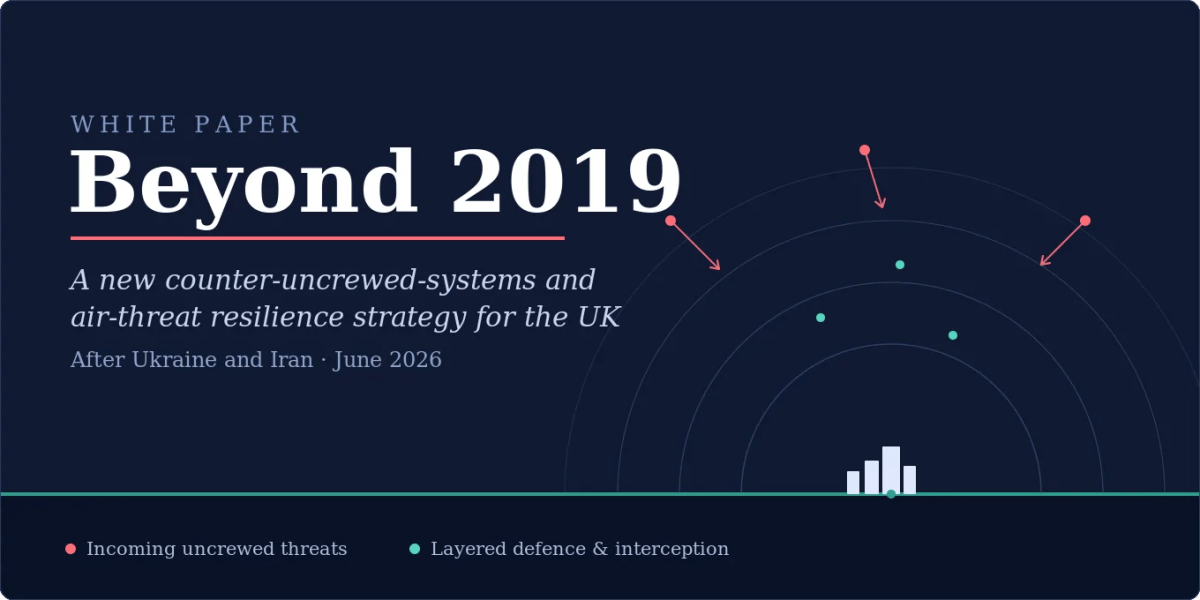
The proposed Counter Uncrewed Systems and Air Threat Resilience Strategy seeks to fuse policy, law, and technology across the Home Office, MoD, Civil Aviation Authority, and NATO‑aligned air‑and‑missile‑defence frameworks. By adopting a layered, cost‑effective baseline—prioritising non‑kinetic defeat options for low‑cost drones while reserving missile intercepts for high‑value threats—the UK can preserve budgetary discipline and maintain operational readiness. Embedding industry standards, export‑control considerations, and rigorous oversight will also bolster strategic autonomy, ensuring the nation can both procure and field resilient counter‑UAS capabilities in an increasingly contested aerial environment.
Beyond 2019
Comments
Want to join the conversation?
Loading comments...