The Brutal Truth About Series B: Only 1 in 3 Deals Even Double Investors’ Money, Per Latest Carta Data
•October 28, 2025
0

Why It Matters
The findings reveal the low probability of meaningful returns at the Series B stage, forcing venture firms to concentrate capital in a few winners and prompting founders to price conservatively and pursue category leadership.
Key Takeaways
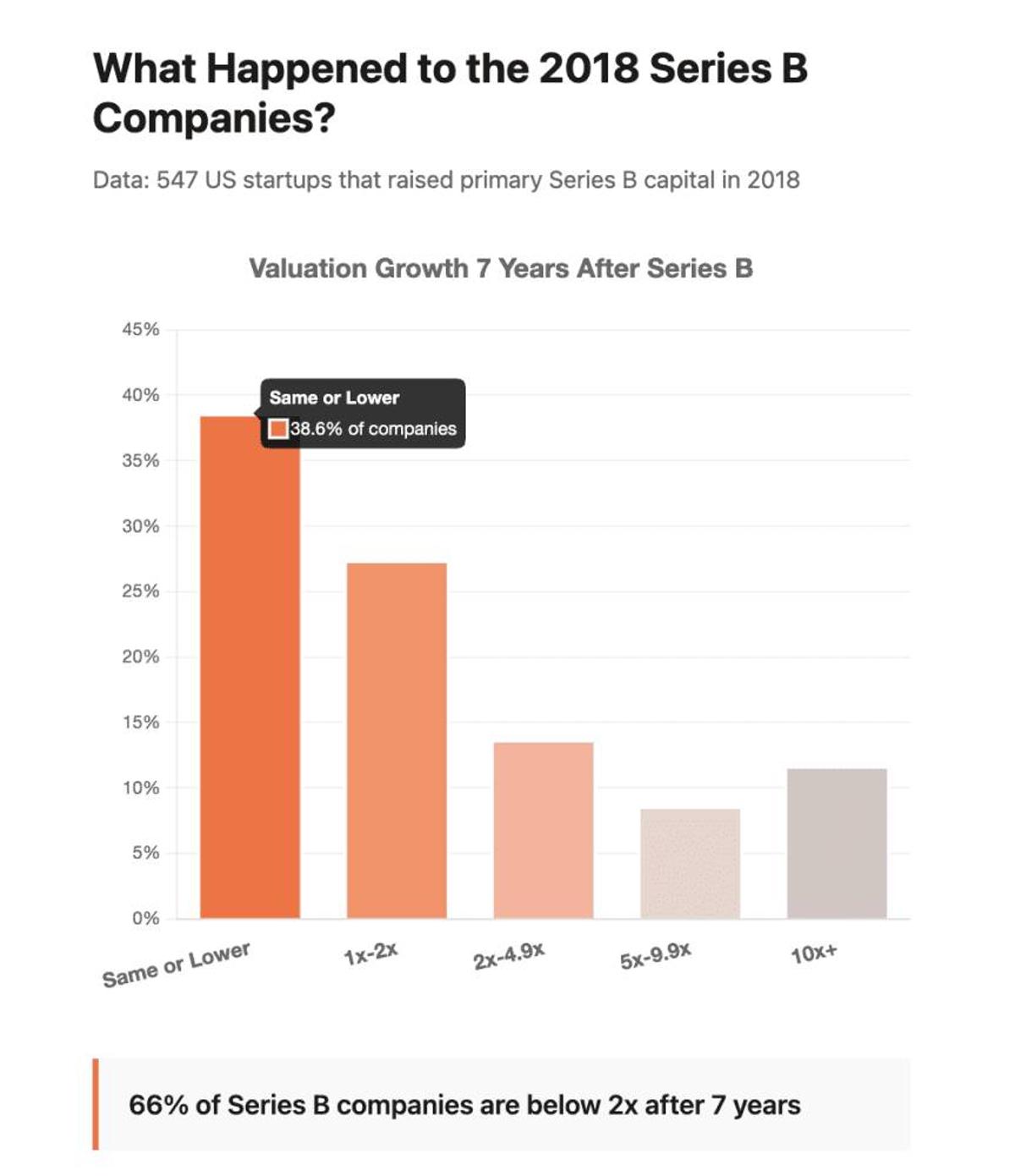
- •66% of 2018 Series B deals underperformed 2× returns.
- •Only 11.7% achieved 10×+ multiples.
- •Valuation discipline crucial for investor upside.
- •Follow‑on capital needed to capture winner upside.
- •Founders must target category dominance, not just PMF.
Pulse Analysis
Series B financing sits at the crossroads of early traction and scaling ambition, yet Carta’s seven‑year follow‑up shows that most companies fail to justify the capital deployed. The power‑law distribution—where roughly 12% of deals generate tenfold returns and the remaining two‑thirds languish below 2×—mirrors the broader venture ecosystem. This concentration means that limited partners rely heavily on a few blockbuster exits to meet their 3×‑plus net‑multiple targets, making the selection process for Series B investors more akin to a high‑stakes lottery than a predictable pipeline.
For venture firms, the data compels a shift toward larger check sizes in a narrower set of high‑conviction bets and a disciplined reserve for follow‑on rounds. By allocating substantial capital to the 10% of deals that can become category leaders, funds can offset the inevitable losses from the 66% that underperform. This approach explains why top‑tier VCs are raising billion‑dollar funds and writing $20‑30 million Series B checks—it's a mathematical necessity to capture the outsized upside of the power‑law tail.
Founders, meanwhile, should treat the median outcome as a warning sign. Pricing the round conservatively, securing investors with deep pockets for future rounds, and building defensible market positions are essential tactics. A focus on category dominance, rather than merely achieving product‑market fit, improves the probability of landing in the elite 10‑plus‑multiple cohort. In a landscape where two‑thirds of Series B companies never return capital, disciplined valuation and strategic growth plans are the only levers founders can pull to tilt the odds in their favor.
The Brutal Truth About Series B: Only 1 in 3 Deals Even Double Investors’ Money, Per Latest Carta Data
0
Comments
Want to join the conversation?
Loading comments...