
Why It Matters
Adopting AI‑native development creates a decisive speed advantage that can determine market leadership in SaaS, while firms that ignore it risk falling irreparably behind.
Key Takeaways
- •AI coding doubles developer output
- •Small teams ship features like large orgs
- •Agentic engineering replaces ticket bureaucracy with natural language
- •Guardrails ensure quality despite rapid AI code
- •Tool choice differentiates prototyping from scalable systems
Pulse Analysis
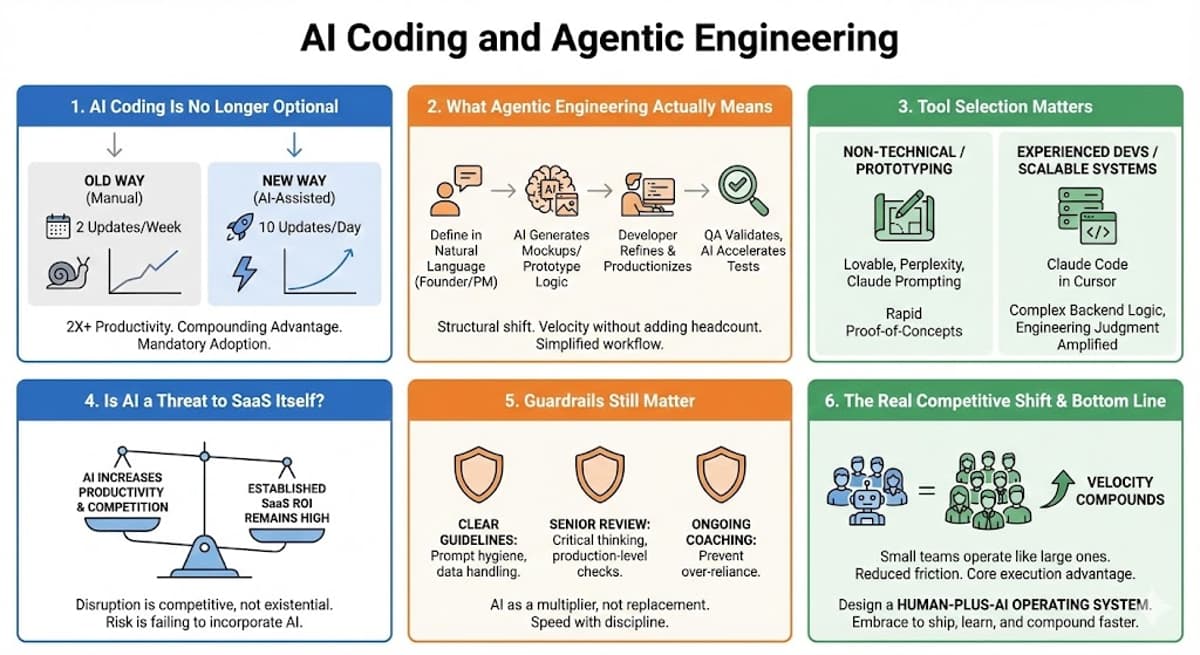
Over the past year AI‑driven coding assistants have moved from novelty to operational necessity. Companies that embed tools such as Cursor powered by Claude report at least a two‑fold increase in developer throughput, turning weeks‑long feature cycles into hours. The productivity boost is not isolated to code generation; QA, documentation, and even UI mock‑ups are accelerated, allowing lean teams to produce output that previously required dozens of engineers. This rapid leverage reshapes cost structures and forces competitors to adopt AI or risk falling behind in feature velocity.
Agentic engineering reframes the traditional ticket‑driven sprint into a human‑plus‑AI workflow. Product managers or founders describe a feature in plain English, the AI generates prototypes, mockups, and starter code, and engineers refine the output into production‑grade systems. This four‑step loop collapses months of design, implementation, and testing into a single day, freeing senior engineers to focus on architecture rather than boilerplate. The approach works across skill levels: non‑technical founders can spin up proof‑of‑concepts with tools like Lovable, while seasoned developers leverage Claude Code inside Cursor for high‑scale back‑ends.
The strategic payoff of AI‑native development is a dramatically narrowed learning curve between startups and incumbents. By compressing feedback loops, firms can iterate, test, and ship ten times more features per day, turning speed into a defensible moat. However, unchecked automation introduces technical debt, so disciplined guardrails—prompt hygiene, senior code review, and data privacy policies—remain essential. As SaaS markets mature, investors will likely prioritize teams that have institutionalized AI workflows, making agentic engineering not just a productivity hack but a core component of future‑ready product strategy.
AI Coding and Agentic Engineering
0
Comments
Want to join the conversation?
Loading comments...