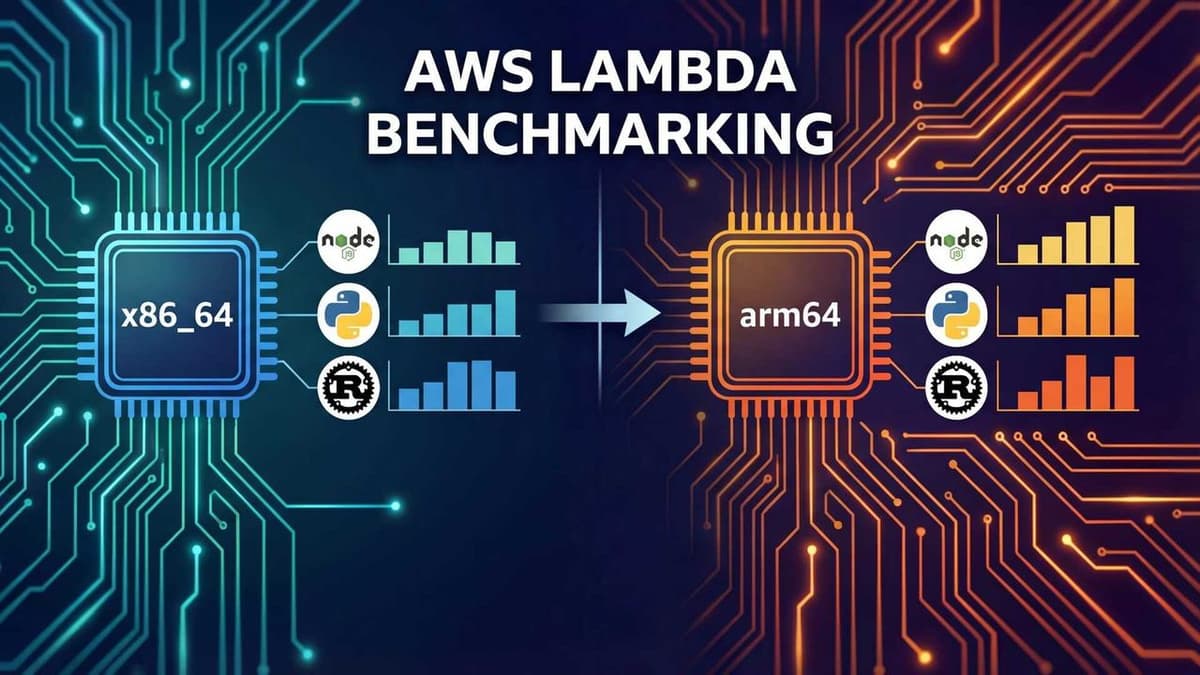
Arm64 Dominates AWS Lambda in 2025: Rust 4-5x Faster than X86, Costs 30% Less Across All Workloads
•December 4, 2025
0
Companies Mentioned

Why It Matters
The performance and cost advantages of arm64 reshape serverless economics, prompting enterprises to migrate workloads for faster response times and lower cloud spend.
Key Takeaways
- •Rust on arm64 runs 4‑5× faster than x86
- •Arm64 cold starts 13‑24% quicker across runtimes
- •Compute costs drop ~30% with arm64, 42% memory‑heavy
- •Python 3.11 and Node.js 22 also see gains
- •Arm64 default for Lambda unless library compatibility issues
Pulse Analysis
The shift toward arm64 in AWS Lambda reflects a broader industry trend favoring energy‑efficient, high‑throughput architectures for serverless computing. Arm’s reduced instruction set and tighter integration with modern silicon allow functions to execute more cycles per watt, delivering tangible latency improvements. For developers, this means faster iteration cycles and the ability to handle bursty traffic without over‑provisioning resources, a critical factor as micro‑service adoption accelerates across enterprises.
Rust’s performance on arm64 stands out because the language’s zero‑cost abstractions align perfectly with the architecture’s low‑level optimizations. Benchmarks reveal that SHA‑256 hashing loops complete up to five times faster, and cold‑start times shrink to a barely perceptible 16 ms. Such gains translate directly into higher throughput for compute‑heavy APIs and data‑processing pipelines, where every millisecond counts. Moreover, the reduced warm‑start variance simplifies capacity planning, allowing teams to predict scaling behavior with greater confidence.
From a financial perspective, the 30% average cost reduction—and up to 42% for memory‑intensive workloads—redefines the economics of large‑scale serverless deployments. Organizations can reallocate savings toward feature development, security enhancements, or multi‑region redundancy. However, migration requires careful dependency auditing to avoid compatibility pitfalls. Companies that proactively adopt arm64‑native builds, especially for Rust, Python 3.11, and Node.js 22 workloads, position themselves to capitalize on both performance and cost efficiencies in the evolving cloud landscape.
Arm64 dominates AWS Lambda in 2025: Rust 4-5x faster than x86, costs 30% less across all workloads
0
Comments
Want to join the conversation?
Loading comments...