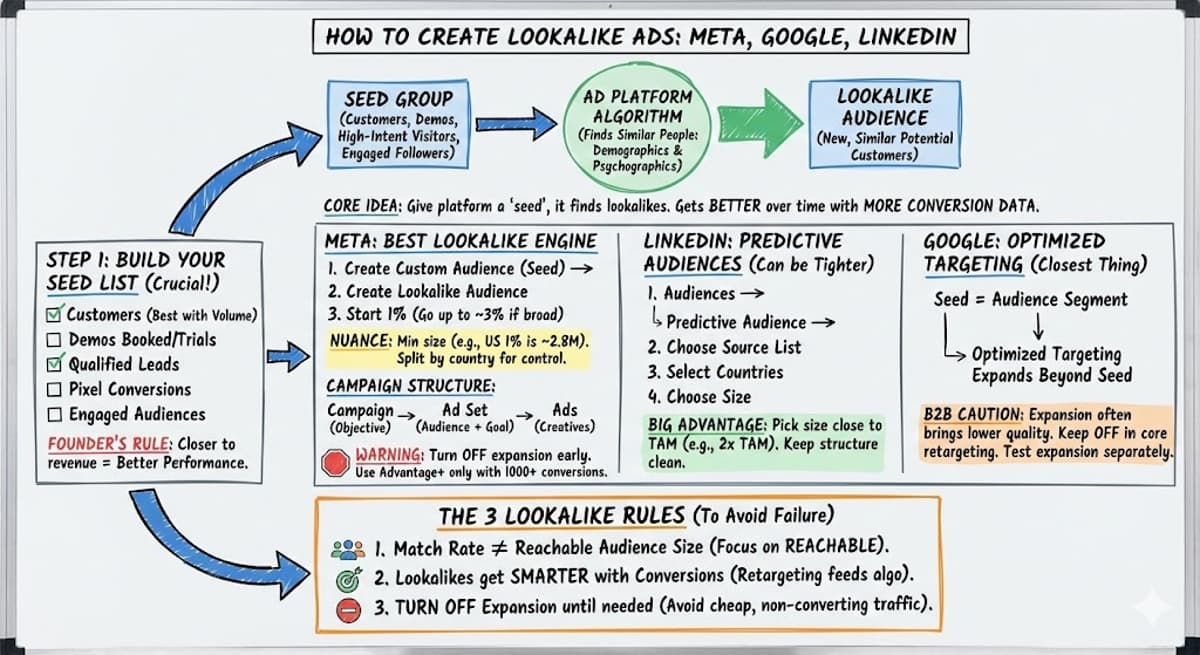
How to Create Lookalike Ads on Meta, Google, and LinkedIn
•January 19, 2026
0

Companies Mentioned


Why It Matters
Effective lookalike audiences amplify acquisition efficiency, lowering cost per lead while scaling pipeline across major ad networks.
Key Takeaways
- •Seed quality drives lookalike performance.
- •Meta’s smallest 1% equals ~2.8M US users.
- •LinkedIn lets you size predictive audiences precisely.
- •Google’s Optimized Targeting replaces traditional lookalikes.
Pulse Analysis
Lookalike audiences hinge on the quality of the seed list you feed the algorithm. Whether you use customers, demo sign‑ups, or engaged followers, the closer that seed is to revenue, the more predictive the expansion will be. Platforms learn from conversion signals, so early retargeting and matched audiences act as the foundation for the algorithm to identify similar users across demographics and psychographics.
Meta remains the gold standard for lookalikes because of its massive data graph, but its minimum audience thresholds—about 2.8 million users for a 1 % US lookalike—force marketers to segment by country to preserve relevance. LinkedIn’s Predictive Audiences give B2B marketers tighter control, allowing custom sizing that can mirror the true total addressable market. Google has retired classic lookalikes, replacing them with Optimized Targeting, which expands a seed at the ad‑group level but can introduce lower‑quality traffic if not isolated in separate campaigns.
Strategically, the three rules highlighted in the guide are essential: measure reachable audience, not just match rate; let conversion data accumulate before enabling expansion; and keep expansion settings off until performance justifies them. By pairing clean campaign structures with disciplined testing—such as separate ad sets for Advantage+ on Meta or dedicated groups for Google’s Optimized Targeting—marketers can quantify incremental lift, protect baseline performance, and sustainably scale demand generation across the major ad ecosystems.
How to Create Lookalike Ads on Meta, Google, and LinkedIn
0
Comments
Want to join the conversation?
Loading comments...