How to Create Matched Audience Ads on Meta, Google, and LinkedIn
•January 16, 2026
0

Companies Mentioned


Why It Matters
Matched audiences let B2B SaaS firms target their entire ideal customer profile, reducing wasted spend and accelerating pipeline growth. Proper execution turns ad spend into a scalable, data‑driven acquisition engine.
Key Takeaways
- •Install pixels and conversion tags before audience uploads.
- •Use platform‑specific CSV templates for higher match rates.
- •Enrich lists with personal emails to double Meta match rate.
- •Exclude retargeting audiences to avoid overlapping impressions.
- •Aim for 20k‑40k matched contacts for sustainable spend.
Pulse Analysis
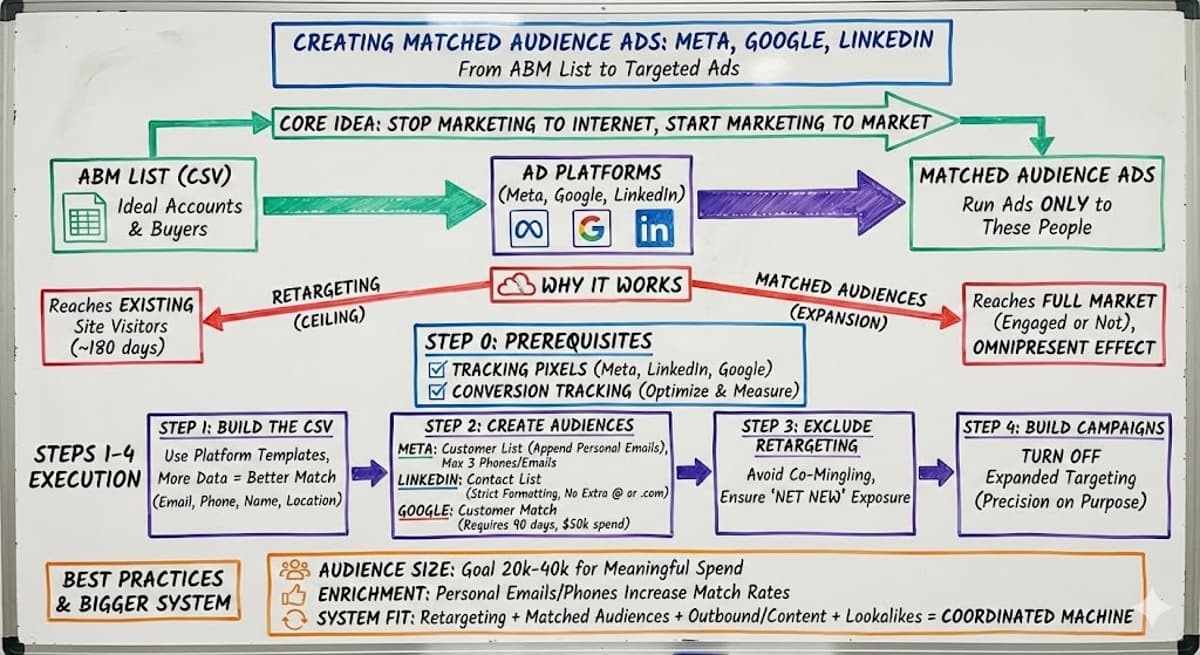
Matched‑audience advertising has become a cornerstone for B2B SaaS marketers seeking to move beyond the limited pool of website visitors. By uploading curated contact lists to Meta, LinkedIn, and Google, brands can appear in front of prospects who have never interacted with their site, creating the "I see you everywhere" effect that drives brand recall and top‑of‑funnel awareness. This layer sits between traditional retargeting and outbound outreach, allowing marketers to blanket their ideal customer profile (ICP) across the platforms where decision‑makers spend their time.
Execution, however, hinges on technical fundamentals. Before any list upload, ensure Meta pixel, LinkedIn Insight Tag, and Google tag are firing and conversion tracking is active; otherwise optimization data will be incomplete. Each platform demands a precise CSV schema—Meta accepts up to three emails and phone numbers per contact, while LinkedIn rejects any stray "@" symbols outside the email column. Enrichment tools that add personal email addresses can lift Meta match rates from roughly 25% to 50%, justifying the modest per‑record cost for high‑ACV accounts. Google imposes a steep eligibility barrier—90‑day account age and $50,000 lifetime spend—so newer advertisers must rely on website‑based audiences until they qualify for Customer Match.
Strategically, matched‑audience campaigns must be insulated from retargeting pools to avoid cannibalizing impressions. Excluding retargeting audiences ensures the ads reach truly new prospects, preserving frequency caps and improving cost efficiency. Marketers should also target a minimum audience size of 20,000‑40,000 matched contacts; smaller pools saturate quickly and limit spend scalability. When integrated with lookalike modeling, outbound outreach, and content nurturing, matched audiences become a catalyst that lowers acquisition costs across the funnel, turning ad spend into a predictable growth lever.
How to Create Matched Audience Ads on Meta, Google, and LinkedIn
0
Comments
Want to join the conversation?
Loading comments...