
Companies Mentioned


Why It Matters
Optimizing landing pages lifts conversion rates, directly reducing customer‑acquisition cost and scaling ad spend efficiency. It turns traffic into predictable, high‑quality leads rather than wasted clicks.
Key Takeaways
- •Target 1‑2% visitor‑to‑lead conversion rate.
- •Lead with a low‑friction, high‑value offer.
- •Remove navigation and distractions for single CTA focus.
- •Prioritize headline, offer, and hero visual over aesthetics.
- •Fast follow‑up halves cost‑per‑lead and boosts conversions.
Pulse Analysis
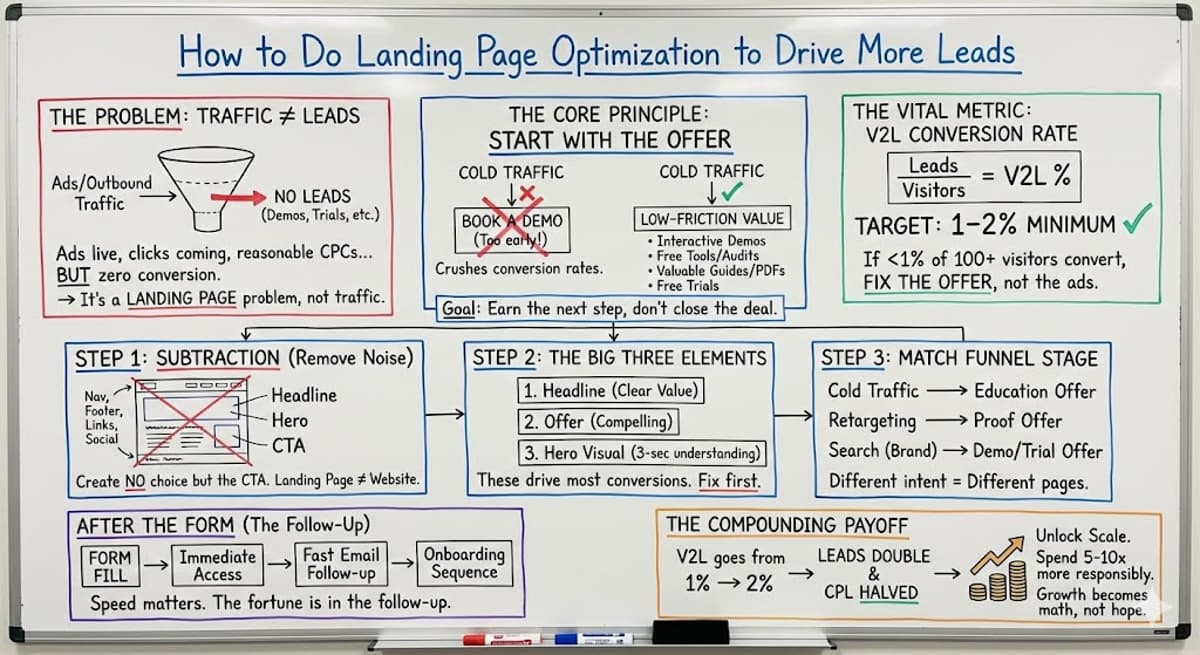
In the B2B SaaS ecosystem, paid and organic traffic often masks a deeper problem: the landing page’s inability to convert visitors into qualified leads. While marketers chase lower CPMs and higher click‑through rates, the visitor‑to‑lead metric remains the true health indicator of a funnel. Industry benchmarks hover around a 1‑2% conversion floor; falling below signals an offer or messaging mismatch rather than a traffic shortfall. Recognizing this shifts budget decisions from buying more clicks to refining the first point of contact.
Effective optimization begins with the offer, not the aesthetics. Cold traffic responds best to low‑commitment incentives such as short demos, interactive walkthroughs, or valuable PDFs that justify an email address. Simultaneously, designers should adopt a minimalist layout—eliminate navigation, footer links, and secondary CTAs—to channel attention toward a single, crystal‑clear call to action. The three pillars—headline clarity, compelling offer, and instantly understandable hero visual—outperform incremental tweaks like button color or font size. Aligning the offer with the visitor’s funnel stage further amplifies relevance, whether it’s educational content for matched‑audience ads or a trial for retargeted users.
The payoff extends beyond the form submission. Immediate delivery of promised assets and rapid follow‑up emails nurture the new lead, accelerating the journey from prospect to customer and dramatically lowering CAC. A modest lift from 1% to 2% V2L can halve cost‑per‑lead, enabling marketers to scale ad spend while maintaining profitability. When landing pages consistently hit the 1‑2% threshold, the entire growth engine becomes more predictable, turning hope‑driven campaigns into data‑driven revenue streams.
How to Do Landing Page Optimization to Drive More Leads
0
Comments
Want to join the conversation?
Loading comments...