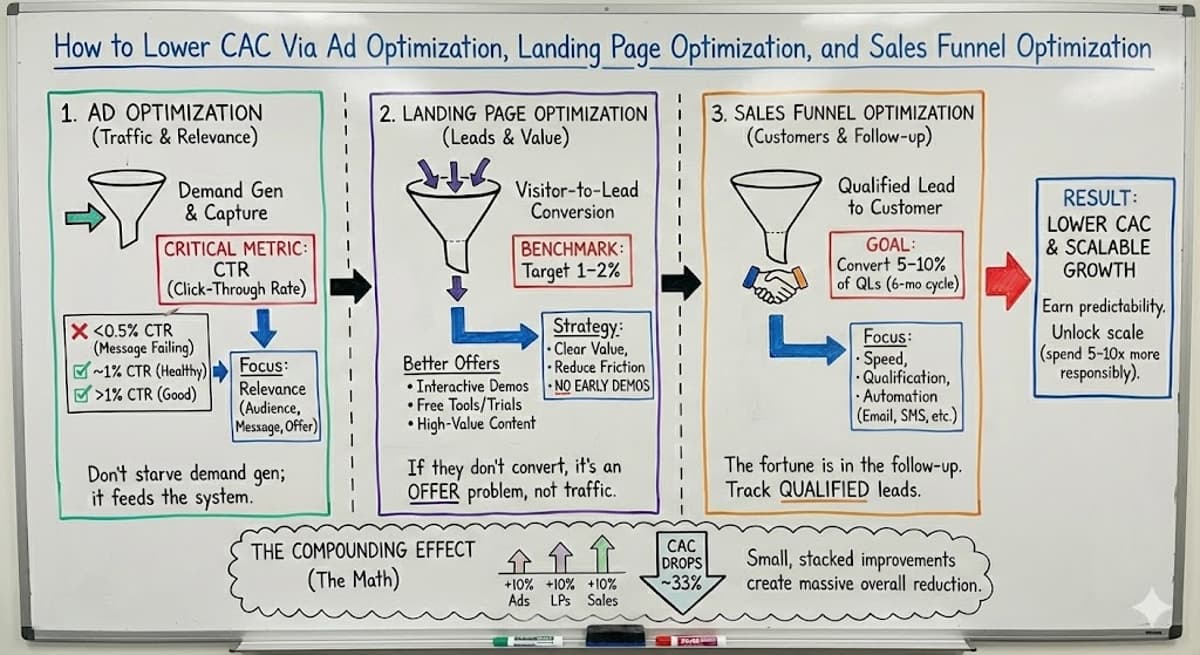
How to Lower CAC Via Ad Optimization, Landing Page Optimization, and Sales Funnel Optimization
•January 30, 2026
0

Companies Mentioned


Why It Matters
A lower CAC transforms ad spend from a cost center into a growth lever, enabling SaaS firms to scale predictably without sacrificing margins.
Key Takeaways
- •CTR below 0.5% signals weak ad relevance.
- •Landing page conversion should hit 1‑2% baseline.
- •Fast, multi‑channel follow‑up cuts qualified‑lead leakage.
- •10% improvements per funnel step slash CAC 33%
Pulse Analysis
In the SaaS arena, CAC is rarely a single‑point failure; it reflects the health of the entire acquisition system. Marketers who treat ads as a standalone expense often miss the tax paid at the top of the funnel—click‑through rate. By boosting relevance, separating demand generation from capture, and targeting a CTR above 1%, companies halve the cost per click and feed a richer pool of prospects downstream, setting the stage for downstream efficiencies.
Landing pages serve as the critical conversion bridge. Industry benchmarks suggest a 1‑2% visitor‑to‑lead rate for B2B SaaS; falling short signals an offer or messaging mismatch rather than a traffic problem. Deploying high‑value assets—recorded demos, free tools, or detailed guides—while stripping navigation and friction can double conversion rates without additional ad spend. This rapid lift in lead quality directly trims CPL and improves the overall CAC equation.
The final lever lies in the sales funnel’s execution. Slow or fragmented follow‑up, inconsistent qualification, and reliance on a single channel erode the gains made upstream. Implementing automated, multi‑touch sequences across email, SMS, voicemail, and retargeting accelerates lead nurturing, while disciplined SDR practices ensure qualified leads convert at 5‑10% within six months. When each funnel stage improves modestly—10% on average—the compounded effect can slash CAC by over 60%, turning a modest budget into a scalable engine for growth.
How to Lower CAC Via Ad Optimization, Landing Page Optimization, and Sales Funnel Optimization
0
Comments
Want to join the conversation?
Loading comments...