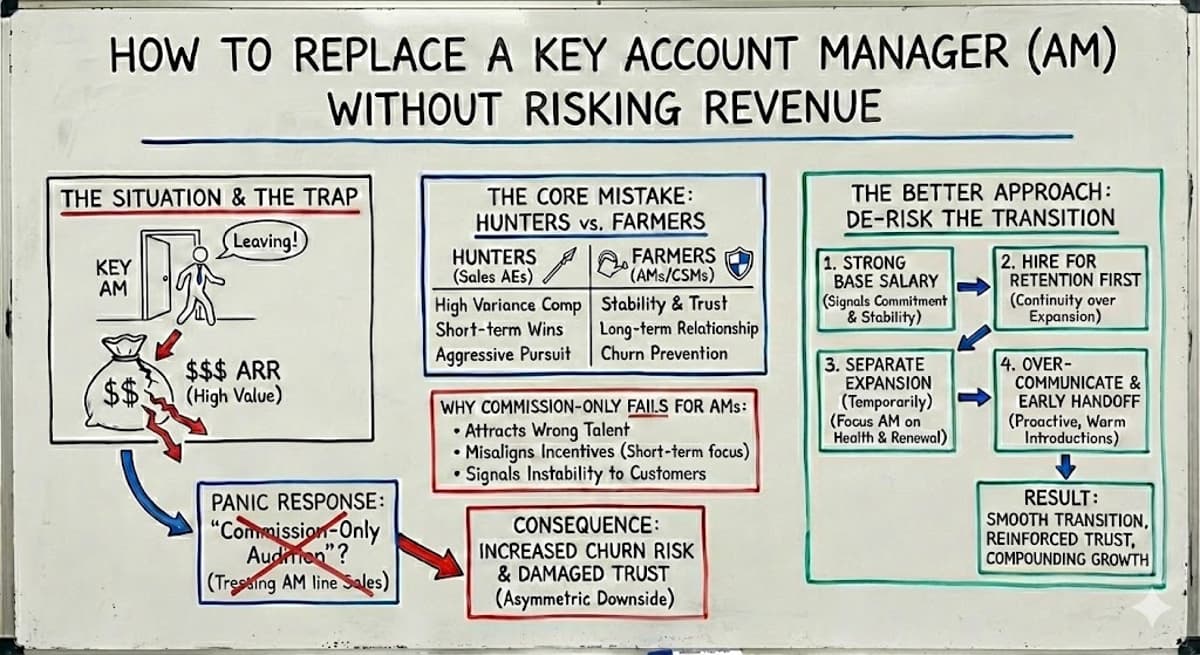
How to Replace an Account Manager Without Risking Your Revenue
•January 14, 2026
0

Companies Mentioned

Why It Matters
Replacing an account manager improperly can trigger churn and revenue loss, directly impacting a SaaS company's growth trajectory and valuation.
Key Takeaways
- •Commission-only hiring repels top account managers
- •Misaligned incentives increase churn risk during transitions
- •Base salary ensures stability and customer trust
- •Separate retention and expansion roles during handover
- •Early, transparent communication smooths client transition
Pulse Analysis
In the SaaS ecosystem, recurring revenue is the lifeblood of valuation, and the account manager serves as the custodian of that stream. Unlike hunters who chase new logos, these “farmers” nurture long‑term relationships, monitor health signals, and act as the trusted liaison between product and client. When a key manager exits, the risk extends beyond a single seat; it reverberates through renewal pipelines, upsell forecasts, and the broader perception of company stability. Understanding this distinction is essential for leadership that aims to safeguard ARR while still pursuing growth.
Compensation design sits at the heart of the transition dilemma. A commission‑only or heavily variable pay structure may appear fiscally prudent, yet it attracts candidates motivated by short‑term payouts rather than relationship stewardship. Studies consistently link misaligned incentives to higher churn rates, especially during handover periods when customers are already sensitive to change. By anchoring the role with a competitive base salary and modest variable components tied to retention metrics, firms align financial rewards with the core objective of preserving existing revenue.
Practical execution demands proactive planning. Companies should initiate the transition as soon as notice is received, orchestrating joint customer calls, detailed knowledge transfers, and a clear communication cadence that reassures clients of continuity. Separating retention duties from expansion initiatives during the first 90 days prevents mixed signals and allows the new manager to focus on risk mitigation. When executed with a stable compensation package and transparent client outreach, the handover not only protects ARR but can also deepen trust, turning a potential disruption into a strategic advantage.
How to Replace an Account Manager Without Risking Your Revenue
0
Comments
Want to join the conversation?
Loading comments...