How to Scientifically Scale Ad Spend to Acquire More Customers
•January 30, 2026
0

Companies Mentioned


Meta
META
Why It Matters
Metric‑based scaling protects customer‑acquisition costs and enables sustainable revenue expansion, a critical advantage in the competitive SaaS market.
Key Takeaways
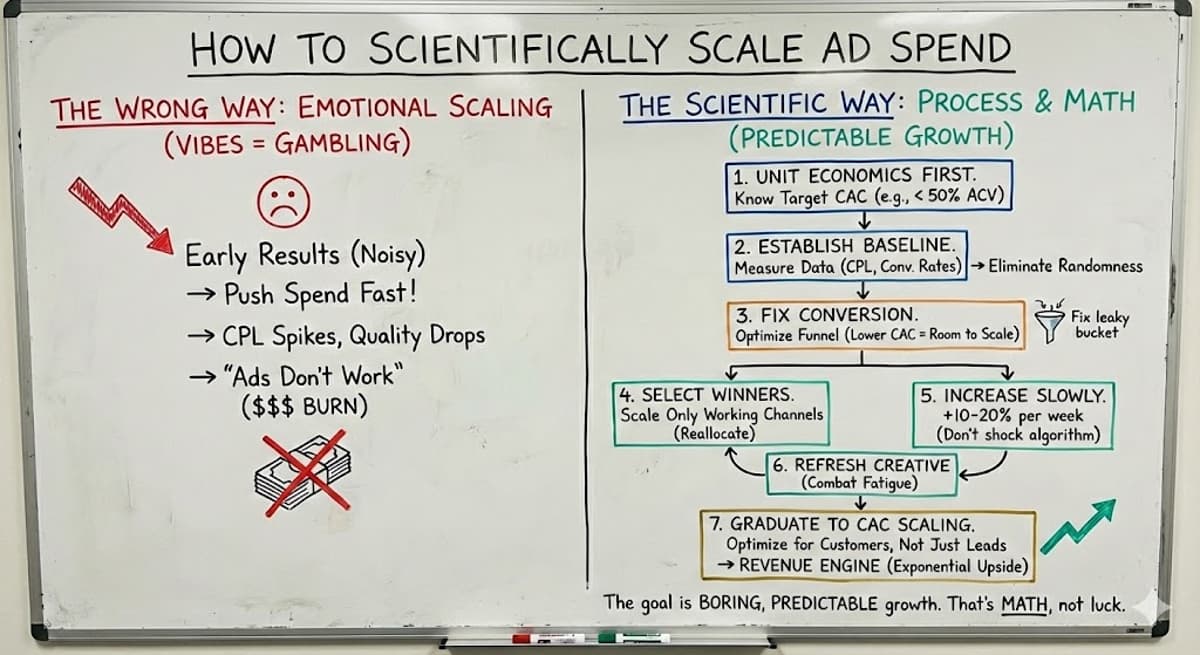
- •Define target CAC using ACV, LTV, payback window
- •Collect baseline CPC, CTR, CPL, conversion rates first
- •Optimize funnel before raising ad budgets
- •Scale budgets 10‑20% weekly, not faster
- •Refresh creative to prevent frequency fatigue
Pulse Analysis
Most SaaS marketers treat paid‑media as a quick‑win channel, cranking up budgets as soon as a few leads appear. This emotional scaling ignores the noisy early data that masks true cost‑per‑lead, conversion rates, and ultimately CAC. By anchoring ad spend to solid unit economics—calculating a target CAC from annual contract value, lifetime value, and acceptable payback periods—companies convert speculation into a math problem. The first step is establishing a clean baseline for each channel, gathering enough impressions to derive reliable CPC, CTR, and lead‑to‑customer metrics before any budget increase.
Once a reliable baseline exists, the focus shifts to funnel efficiency. Improving visitor‑to‑lead, lead‑to‑qualified‑lead, and qualified‑lead‑to‑customer conversion rates by even ten percent can slash CAC by a third, creating headroom for additional spend. Scaling then becomes selective: allocate more budget to channels that already meet the target CAC, and do so incrementally—typically ten to twenty percent per week—to avoid algorithmic disruption and audience fatigue. Parallel to budget adjustments, creative assets must be refreshed regularly; rising frequency without new copy or visuals quickly depresses CTR and inflates CAC.
The payoff of this disciplined, scientific approach is predictability. When CAC stays within the predefined range, ad spend transforms into a reliable revenue engine rather than a cost sink, bolstering cash‑flow forecasts and investor confidence. Companies that master this process can multiply their ad budgets from a few thousand to six‑figure monthly spends while maintaining healthy margins. In a market where growth velocity is a key differentiator, treating ad scaling as a continuous experiment—driven by data, incremental changes, and ongoing optimization—offers a sustainable competitive edge.
How to Scientifically Scale Ad Spend to Acquire More Customers
0
Comments
Want to join the conversation?
Loading comments...