How to See Your Competitors' Ads with Meta Ads Library, Google Ads Library, and LinkedIn Ads Library
•January 9, 2026
0

Companies Mentioned


Why It Matters
Ad libraries provide free, real‑time market intelligence that sharpens targeting and reduces guesswork, directly impacting ad spend efficiency and growth strategy.
Key Takeaways
- •Ad libraries reveal winning creative themes.
- •Consistent ads indicate strong performance.
- •Google library shows search intent signals.
- •LinkedIn ads confirm B2B pipeline investment.
- •Analyze patterns, not copy exact copy.
Pulse Analysis
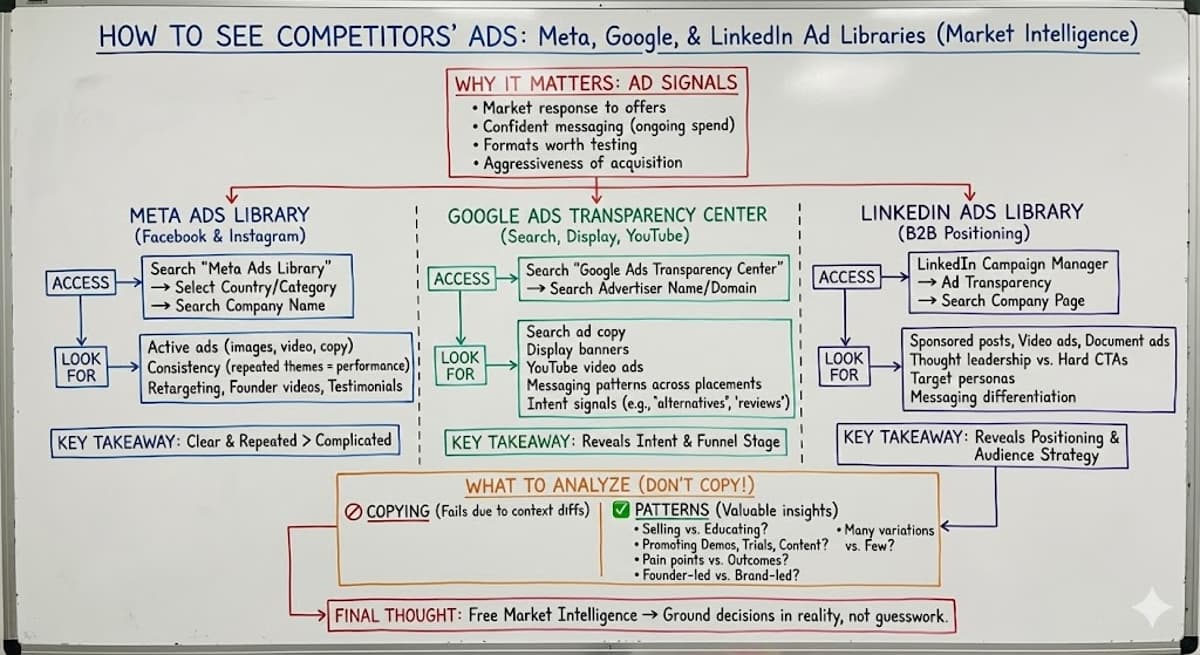
Since the rise of digital advertising, regulators and platforms have made ad placements publicly searchable, creating the Meta Ads Library, Google Ads Transparency Center, and LinkedIn Ads Library. These tools were originally intended to combat misinformation, but marketers quickly recognized their secondary value as a free source of market intelligence. By exposing every active campaign, the libraries let businesses see which offers, creatives, and formats survive the platform’s performance filters. This transparency turns ad spend into a data point, allowing companies to benchmark competitors without costly third‑party research.
Practically, each library serves a distinct purpose. Meta’s library is the quickest entry point; it displays full‑screen images, video loops, and copy for Facebook and Instagram ads, making it easy to spot recurring visual motifs and founder‑led videos that indicate high click‑through rates. Google’s center aggregates search text ads, display banners, and YouTube spots, revealing the keyword clusters and funnel stages where rivals allocate budget—particularly “alternatives” or “review” phrasing that signals buyer intent. LinkedIn, though less obvious to navigate, surfaces sponsored posts and document ads, which are costly and therefore a strong indicator of B2B pipeline focus.
The real advantage comes from turning these observations into testable hypotheses. Marketers should catalog recurring formats—such as founder videos on Meta or intent‑driven search copy on Google—and run small‑scale experiments to validate whether the same signals hold for their own audience. At the same time, they must avoid the trap of direct replication; brand voice, pricing, and target personas differ, so the focus should be on structure, messaging themes, and budget allocation patterns. When integrated into a disciplined testing framework, ad‑library intelligence reduces guesswork, shortens the learning cycle, and ultimately drives a higher return on ad spend.
How to See Your Competitors' Ads with Meta Ads Library, Google Ads Library, and LinkedIn Ads Library
0
Comments
Want to join the conversation?
Loading comments...