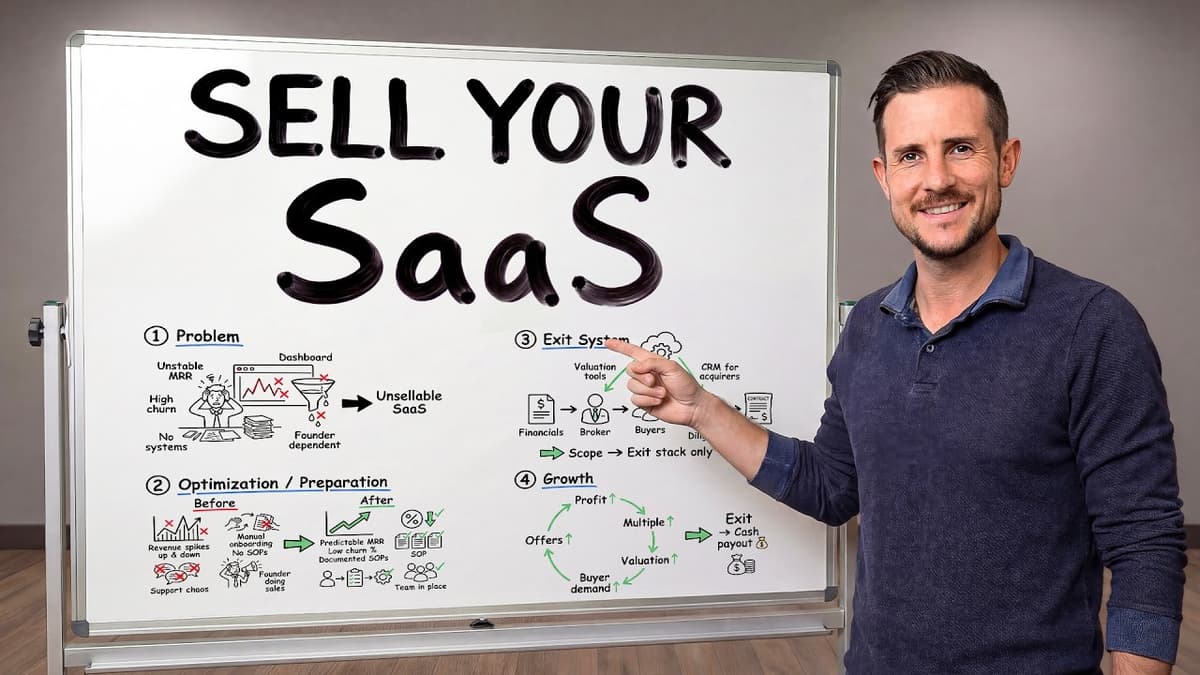
How to Sell Your SaaS (From a Founder with a $169m Exit)
•February 21, 2026
0

Why It Matters
A SaaS built on repeatable processes and solid economics attracts higher acquisition multiples, turning growth into a strategic asset rather than founder‑dependent hustle.
Key Takeaways
- •Exit‑ready SaaS focuses on scalable growth, not founder hustle
- •LTV must exceed CAC; aim six‑month payback
- •Profitable paid acquisition drives mechanical growth
- •Omnipresent branding shortens sales cycles
- •Build systems so business runs without founder
Pulse Analysis
In today’s crowded B2B cloud market, founders quickly learn that a "lifestyle" SaaS—designed for cash flow and personal freedom—rarely commands premium valuations. Buyers seek enterprises that resemble machines: repeatable revenue, transferable processes, and depth beyond a single visionary. By aligning product strategy with enterprise‑grade unit economics—tracking ARPA, churn, LTV, and CAC—companies can prove predictable growth, a critical signal for investors and acquirers alike. This disciplined approach transforms growth from a gamble into a quantifiable engine, positioning the business for strategic exits rather than opportunistic sales.
The shift from founder‑led sales to scalable paid acquisition is the linchpin of high‑value SaaS. A six‑to‑twelve‑month CAC payback, coupled with LTV substantially higher than acquisition cost, turns advertising spend into a lever rather than a liability. When combined with an omnipresent brand strategy—AI‑personalized outbound emails, LinkedIn content, and retargeted ads—prospects encounter the company at multiple touchpoints, shortening sales cycles and boosting conversion rates. A robust sales and customer‑success organization further enhances net revenue retention, turning expansion revenue into a valuation multiplier.
Capital should amplify, not substitute, solid fundamentals. Raising funds only after establishing predictable acquisition, healthy payback windows, and autonomous teams ensures that additional dollars accelerate growth without diluting ownership. Ultimately, the decisive factor for acquirers is transferability: can the business thrive without the founder’s daily involvement? Building systematic processes, deep leadership benches, and clear financial metrics creates a self‑sustaining operation that commands higher multiples and smoother transitions during M&A activity.
How to Sell Your SaaS (from a Founder with a $169m exit)
0
Comments
Want to join the conversation?
Loading comments...