How to Set up Paid Search on Google and Bing for SaaS Companies
•January 23, 2026
0

Companies Mentioned


Why It Matters
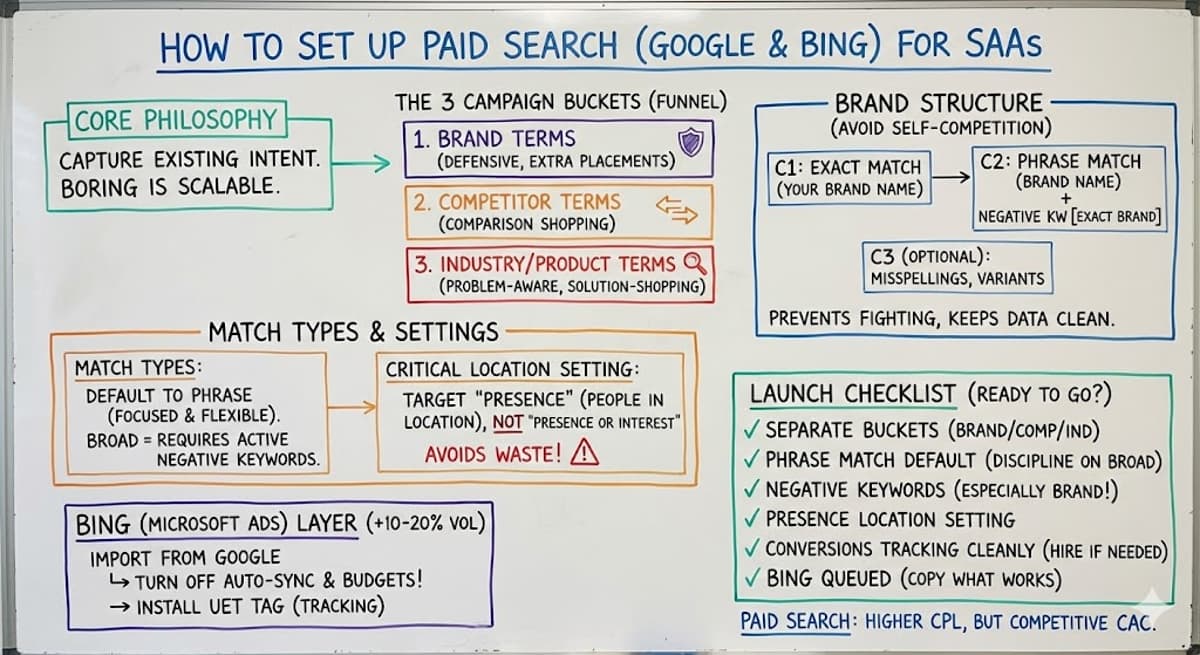
A disciplined paid‑search framework reduces wasted spend, improves data quality, and unlocks additional qualified leads for SaaS firms, directly impacting customer‑acquisition cost and growth velocity.
Key Takeaways
- •Use three campaign buckets: brand, competitor, industry
- •Structure brand campaigns with exact, phrase, misspellings, negatives
- •Default to phrase match; manage broad match carefully
- •Set location targeting to Presence, not interest
- •Add Bing for extra 10‑20% volume, import from Google
Pulse Analysis
Paid‑search for SaaS companies thrives on a clear segmentation strategy. By dividing campaigns into brand, competitor, and industry/product buckets, marketers can align ad copy with the buyer’s stage—from defensive brand protection to capturing comparison shoppers and attracting problem‑aware prospects. This tri‑fold approach simplifies budget allocation, ensures each keyword group receives tailored messaging, and creates a data hierarchy that makes performance analysis more actionable. In practice, the brand bucket often yields the highest click‑through rates, while competitor and industry terms drive the most qualified conversions.
Technical execution matters as much as strategic planning. A proven brand structure—exact‑match, phrase‑match with a negative for the exact term, and a misspelling tier—prevents internal competition and delivers cleaner performance metrics. Phrase match should be the default for non‑brand campaigns because it balances relevance with reach; broad match can uncover hidden volume but requires vigilant search‑term reviews and aggressive negatives. Location targeting set to "Presence" eliminates irrelevant international traffic, and early bidding on Max Conversions gathers reliable conversion data, while Target Impression Share can safeguard brand visibility without inflating costs. Robust conversion tracking, even via outsourced specialists, is essential for accurate CAC calculations across channels.
Extending the framework to Microsoft Ads adds a modest yet valuable 10‑20% lift in search volume at comparable CAC. Importing Google campaigns into Bing streamlines setup, but marketers must disable auto‑sync to avoid budget duplication. Ensuring the UET tag is active completes the measurement loop. A concise launch checklist—segregated campaigns, phrase‑match defaults, negative keyword hygiene, presence‑only locations, verified conversions, and a ready‑to‑go Bing layer—provides a repeatable playbook. When executed correctly, this disciplined approach transforms paid search from a cost center into a scalable acquisition engine for SaaS businesses.
How to Set up Paid Search on Google and Bing for SaaS Companies
0
Comments
Want to join the conversation?
Loading comments...