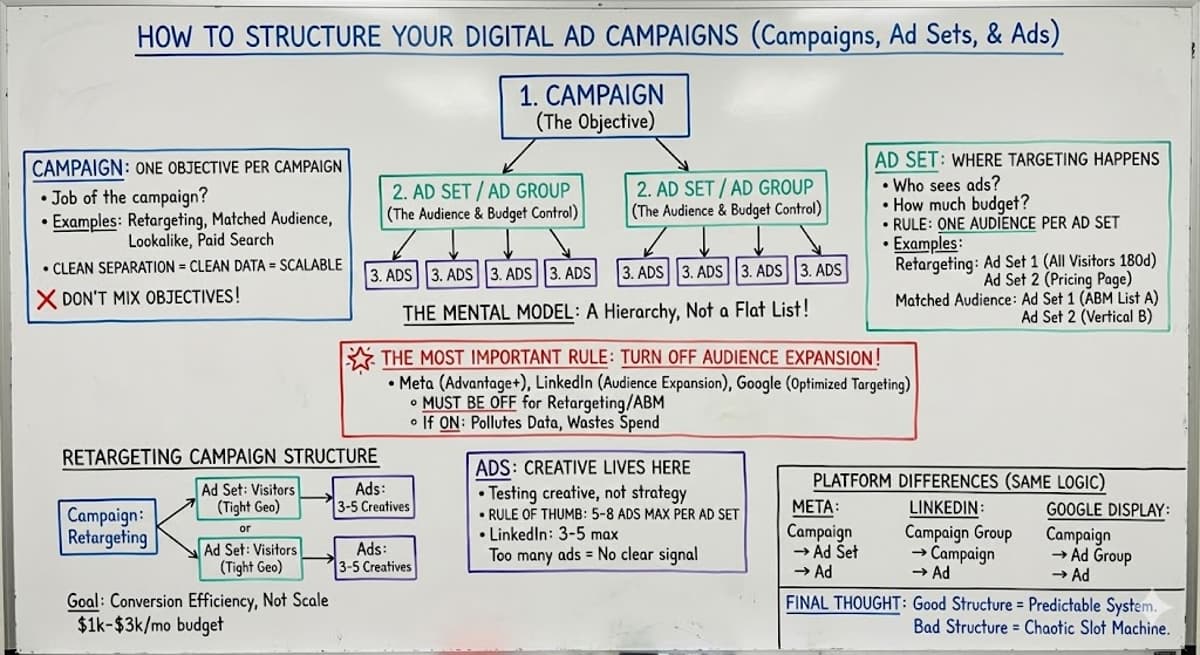
How to Structure Your Digital Ad Campaigns (Campaigns, Ad Sets, & Ads)
•January 9, 2026
0

Companies Mentioned


Why It Matters
A disciplined campaign architecture eliminates data pollution and lets algorithms optimize toward true business goals, directly lowering CPL and CAC for B2B SaaS firms. This translates into faster, more reliable revenue pipelines and scalable paid‑media growth.
Key Takeaways
- •One objective per campaign.
- •One audience per ad set.
- •Turn off audience expansion.
- •Limit ads per ad set (5‑8).
- •Separate demand‑gen and demand‑capture campaigns.
Pulse Analysis
A hierarchical ad structure is not a nice‑to‑have—it’s the foundation of algorithmic efficiency. When platforms see a single objective at the campaign level, they can allocate budget to the metric that matters, whether that’s clicks, conversions, or brand lift. Mixing goals blurs the signal, forcing the machine to guess, which inflates cost per result and erodes confidence in reporting. Clean separation therefore creates a reliable feedback loop that marketers can trust for optimization decisions.
The practical rules are straightforward but often ignored. Assign each campaign a sole purpose—retargeting, lookalike awareness, or paid search—so the platform’s learning engine receives an unambiguous signal. Within each campaign, build ad sets around a single audience segment and lock budget to that set; this prevents cross‑contamination of performance data. Crucially, disable Meta’s Advantage+, LinkedIn’s Audience Expansion, and Google’s Optimized Targeting for ABM and retargeting efforts, as these settings dilute the precision of CPL and CAC calculations. Creative testing should stay lean, with no more than five to eight ads per ad set, ensuring each variation gathers enough impressions to generate statistical insight.
For B2B SaaS teams, disciplined structure unlocks scalable growth. Separate demand‑generation (matched audiences, thought‑leader content) from demand‑capture (retargeting, search) campaigns, allowing intentional budget allocation and clear attribution of pipeline contributions. This systematic approach transforms paid media from a gamble into a repeatable engine, enabling marketers to iterate weekly, predict spend efficiency, and align ad performance with broader revenue targets.
How to Structure Your Digital Ad Campaigns (Campaigns, Ad Sets, & Ads)
0
Comments
Want to join the conversation?
Loading comments...