Managing Software Quality Assurance (QA) While Using Agentic Engineering and AI Coding
•February 18, 2026
0

Why It Matters
Without redesigning QA, the speed gains become sources of hidden instability, threatening product reliability and competitive advantage. Structured, AI‑augmented QA ensures rapid releases remain safe and scalable.
Key Takeaways
- •AI compresses development cycles from weeks to days
- •QA must shift from checkpoint to orchestrated system
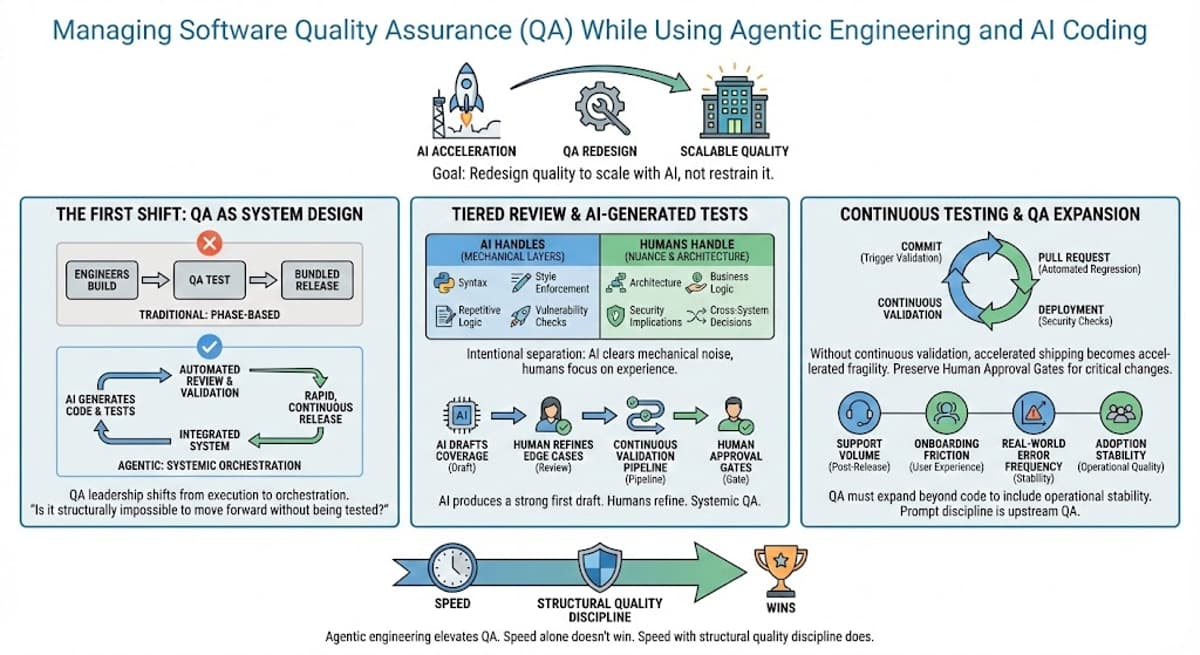
- •Tiered review lets AI handle mechanical checks, humans handle nuance
- •Continuous testing on every commit prevents accelerated fragility
- •Prompt discipline acts as upstream quality control
Pulse Analysis
Agentic engineering, the practice of letting large language models write, test, and refactor code, has turned traditional development timelines on their head. What once required months of coordinated effort can now be completed in a single day, as illustrated by migrations that finished within 24 hours. This dramatic compression, however, reshapes the risk landscape: defects that would have been caught in a later QA phase now surface instantly, potentially propagating through the codebase. Companies that ignore this shift risk turning speed into fragility, while those that adapt can capture a decisive market edge.
The answer lies in treating quality assurance as a system‑design problem rather than a sequential gate. AI excels at deterministic tasks—syntax checks, style enforcement, and routine vulnerability scans—allowing it to perform Tier 1 and Tier 2 reviews automatically. Human engineers then concentrate on high‑level concerns such as architectural integrity, business‑logic correctness, and security implications. By generating a draft test matrix, AI supplies an initial coverage layer that QA refines, creating a continuous testing pipeline where every commit triggers regression, security, and performance validation. This orchestration delivers both speed and rigor.
Beyond code, modern QA must monitor operational health, including onboarding throughput, support volume, and real‑world error rates. Prompt engineering emerges as an upstream quality lever: disciplined, version‑controlled prompts shape the behavior of code‑generating agents before any line is written. Maintaining human approval gates for critical changes—authentication, billing, database migrations—preserves accountability while leveraging automation for routine work. Organizations that embed these practices achieve a scalable quality framework that matches AI‑accelerated development, turning rapid iteration into sustainable growth rather than a source of technical debt.
Managing Software Quality Assurance (QA) While Using Agentic Engineering and AI Coding
0
Comments
Want to join the conversation?
Loading comments...