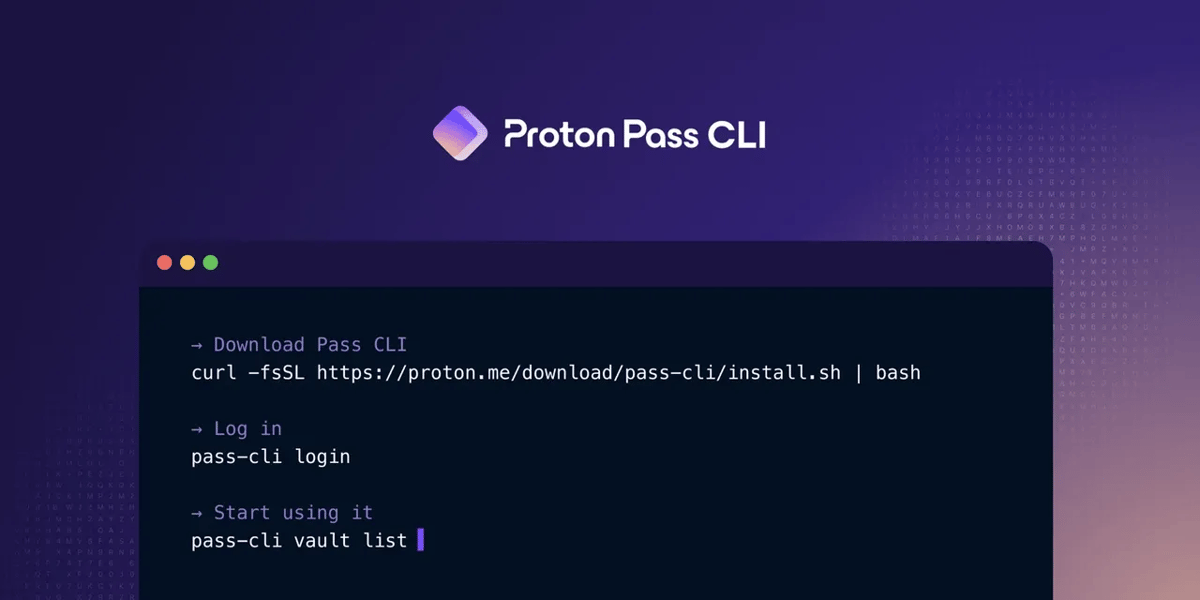
Proton Pass Just Made It Even Easier for Developers to Retrieve Secrets — and That's a Win for Everyone Involved
•December 10, 2025
0
Companies Mentioned

Why It Matters
The CLI bridges the gap between consumer password managers and DevOps tooling, allowing secure, automated secret handling in CI/CD pipelines and accelerating development workflows.
Key Takeaways
- •Proton Pass launches CLI for secret retrieval.
- •CLI works across Pass Plus, Family, Professional, bundles.
- •Enables scripted automation in CI/CD, containers.
- •Maintains end‑to‑end encryption for injected credentials.
- •Free users must upgrade to access CLI.
Pulse Analysis
The rise of DevOps and automated pipelines has pushed password managers beyond simple consumer utilities toward developer‑centric solutions. Proton Pass’s new command‑line interface (CLI) reflects this shift, giving engineers the ability to pull secrets directly from the terminal without opening a graphical app. By supporting the full feature set of the native client—passwords, notes, credit cards, vault management—the CLI turns Proton Pass into a programmable credential store. This move aligns the service with other enterprise‑grade secret managers and positions it for deeper integration in modern software delivery workflows.
Security remains the cornerstone of the offering. The CLI leverages Proton’s end‑to‑end encryption, ensuring that credentials are never exposed in plaintext, even when injected into scripts or CI/CD jobs. App‑password authentication further isolates access, allowing tokens to be scoped for specific environments such as containers or headless servers. For development teams, this translates into faster build times and reduced context‑switching, as secrets can be fetched programmatically without manual copy‑paste. The approach also satisfies compliance requirements by maintaining audit trails and limiting secret exposure.
From a market perspective, extending the CLI to paid tiers—Pass Plus, Family, Professional, and all Proton bundles—creates a clear upgrade incentive, potentially boosting subscription revenue. Competitors like 1Password and HashiCorp Vault already offer similar command‑line capabilities, so Proton Pass’s entry narrows the feature gap and may attract security‑focused startups seeking a unified consumer‑grade and enterprise‑grade solution. As more organizations adopt zero‑trust principles, tools that blend strong encryption with developer convenience will gain traction. Proton’s strategy of bundling the CLI with its broader privacy ecosystem could drive ecosystem lock‑in and long‑term growth.
Proton Pass just made it even easier for developers to retrieve secrets — and that's a win for everyone involved
0
Comments
Want to join the conversation?
Loading comments...