
Why It Matters
Because NRR directly impacts valuation and long‑term profitability, aligning customer success with revenue metrics transforms growth from linear to exponential.
Key Takeaways
- •NRR drives SaaS growth more than new logo acquisition
- •Ideal CSM workload: $1‑2M ARR per manager
- •Blend retention and expansion bonuses for balanced CSM incentives
- •Align CSM compensation directly to NRR and churn metrics
- •Proactive QBRs and health checks prevent churn
Pulse Analysis
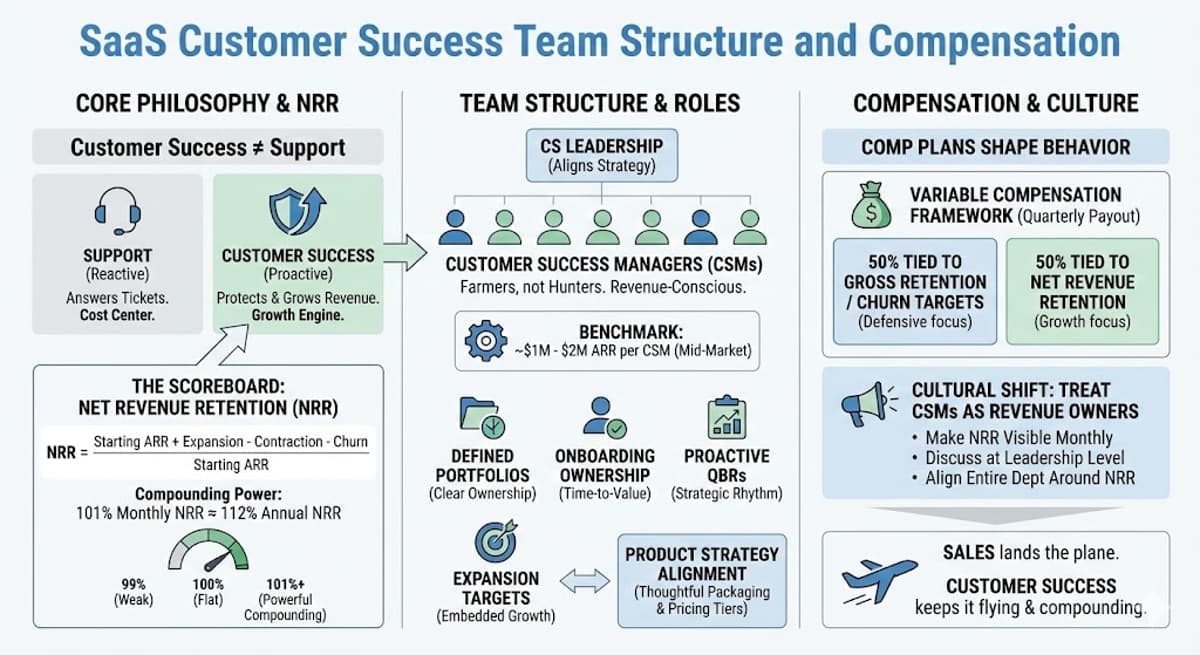
In the SaaS market, investors have long prized rapid logo acquisition, yet the financial engine that sustains valuation is net revenue retention (NRR). NRR captures both churn avoidance and expansion revenue from existing customers, and a single‑digit shift in monthly NRR can translate into double‑digit annual growth. Companies that treat NRR as a core KPI gain visibility into the health of their subscription base, allowing leadership to forecast cash flow with greater confidence. Consequently, the industry is moving toward a retention‑first mindset, where customer success becomes a revenue discipline rather than a cost center.
Building a scalable customer success organization starts with the right headcount‑to‑ARR ratio. Benchmarks suggest a mid‑market CSM should manage between $1 million and $2 million of annual recurring revenue, with tighter ratios for high‑touch enterprise accounts. This portfolio size enables proactive onboarding, regular quarterly business reviews, and timely upsell conversations without overburdening the manager. When CSMs are equipped to monitor account health and intervene early, churn rates drop and expansion pipelines thicken, turning the back half of the funnel into a predictable growth engine.
Compensation design is the lever that translates strategy into behavior. A balanced plan—typically 50 % of variable pay tied to gross retention or churn targets and 50 % to NRR—encourages CSMs to protect existing revenue while actively pursuing expansion. Transparent quarterly payouts and clear ARR ownership reinforce accountability. Moreover, aligning product roadmaps with success teams ensures new features are positioned for upsell, creating a virtuous loop where customer value and company revenue grow together.
SaaS Customer Success Team Structure and Compensation
0
Comments
Want to join the conversation?
Loading comments...