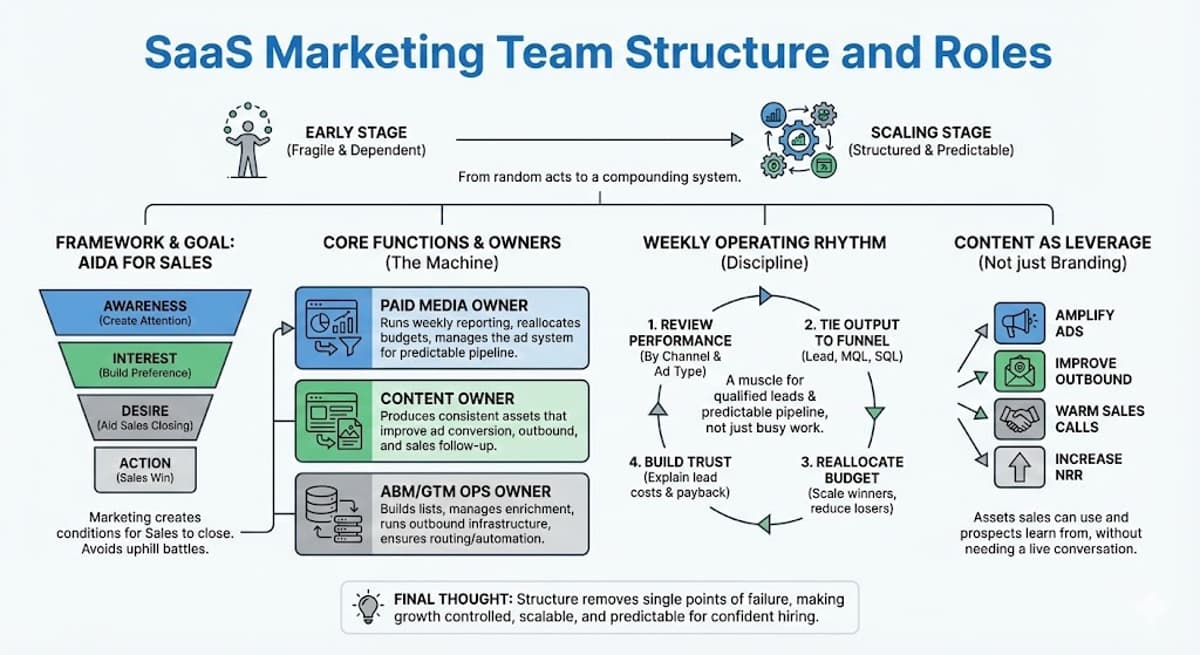

Why It Matters
Without a structured marketing engine, SaaS companies risk wasted spend, unpredictable pipelines, and sales friction, limiting their ability to scale efficiently.
Key Takeaways
- •Marketing must evolve beyond founder‑led scrappy tactics
- •Full‑funnel structure prevents costly channel misallocation
- •Paid media, content, and ABM owners drive scalability
- •Weekly metrics cadence turns marketing into investment
- •Content assets amplify ads, outbound, and sales
Pulse Analysis
As SaaS companies cross the $5 M ARR threshold, the informal, founder‑centric marketing model that survived the startup phase begins to crumble. The primary failure point is treating marketing as a single channel rather than a continuous, full‑funnel system that creates market awareness, nurtures interest, and hands off qualified prospects to sales. When the function lacks clear roles, budget decisions become reactive, often favoring low‑cost CPL metrics while starving the upstream activities that generate sustainable demand. A structured approach transforms marketing from a cost center into a growth engine that scales with the business.
The most effective SaaS marketing org clusters around three ownership pillars: paid‑media, content, and ABM/GTM‑ops. Each owner is responsible for a self‑contained “machine” that produces data, optimizes spend, and delivers assets to the sales pipeline. Coupled with a disciplined weekly rhythm—reviewing CPM, CPC, CTR, lead quality, and funnel conversion—teams can reallocate budget to the top‑performing levers and prune under‑performing tactics without destabilizing the whole system. This cadence not only improves ROI but also builds credibility with leadership, turning marketing spend into a predictable, investable asset.
Content, often mislabeled as branding, is actually the leverage that amplifies every outbound and paid initiative. High‑quality assets—case studies, playbooks, and video demos—feed the ABM engine, warm prospects before sales outreach, and shorten sales cycles, directly boosting net‑revenue retention. When content is produced with clear sales enablement intent, it becomes a reusable library that reduces acquisition costs and supports expansion opportunities. Aligning the content team with ABM and paid‑media owners ensures that messaging stays consistent across touchpoints, creating a cohesive customer journey that scales alongside the company’s growth ambitions.
SaaS Marketing Team Structure and Roles
0
Comments
Want to join the conversation?
Loading comments...