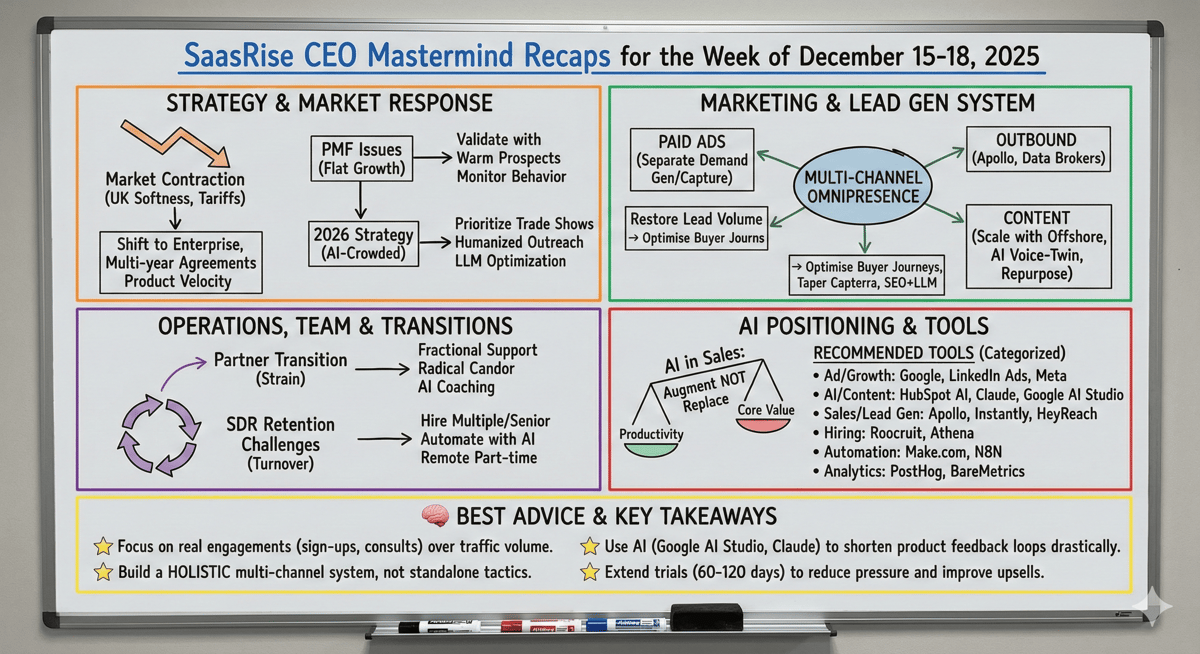
SaasRise CEO Mastermind Recaps for the Week of December 15-18, 2025
•December 18, 2025
0

Companies Mentioned





Why It Matters
In a tightening economy, these tactics help SaaS firms stabilize revenue, differentiate AI offerings, and build resilient, cost‑effective growth engines essential for surviving and thriving into 2026.
Key Takeaways
- •Shift to enterprise, multi-year deals amid market contraction
- •Validate product‑market fit via competitor analysis and warm prospects
- •Position AI as productivity enhancer, keep optional for sensitive markets
- •Build unified multi‑channel system combining paid, outbound, content, SEO
- •Hire senior or multiple SDRs; automate with AI for retention
Pulse Analysis
The SaaS landscape in late 2024 is being reshaped by a confluence of macro‑economic headwinds and rapid AI adoption. As UK demand softens and pipeline attrition reaches 60%, founders are forced to re‑engineer go‑to‑market models, prioritising enterprise accounts and multi‑year contracts that smooth revenue volatility. This strategic pivot aligns with a broader industry trend where high‑touch sales cycles are being shortened through AI‑driven insights, allowing companies to identify high‑value prospects faster while preserving margin.
Equally critical is the nuanced positioning of artificial intelligence within product suites. Buyers are skeptical of AI as a wholesale replacement, especially in regulated sectors, prompting vendors to frame AI as an optional productivity layer rather than a core requirement. By decoupling AI features and emphasizing the underlying product value, SaaS firms can mitigate procurement resistance and retain flexibility across diverse buyer personas. Thought leadership, trade‑show visibility, and LLM‑optimized content further differentiate brands in an increasingly crowded AI‑first marketplace.
Operationally, the mastermind underscores the need for a holistic, omnichannel marketing engine. Integrating paid media, outbound sequencing, SEO, and in‑app messaging creates constant market presence and reduces reliance on costly acquisition channels like Capterra. Simultaneously, scaling sales capacity through senior SDR hires, remote teams, and AI‑augmented workflows addresses churn and talent attrition. Companies that synchronize these tactics—enterprise focus, AI‑aware positioning, and unified demand generation—are poised to sustain growth despite the prevailing market contraction.
SaasRise CEO Mastermind Recaps for the Week of December 15-18, 2025
0
Comments
Want to join the conversation?
Loading comments...