Scaling Ad Budgets Profitably on Meta, LinkedIn, Google, and Bing
•February 6, 2026
0

Companies Mentioned


Why It Matters
Profitable scaling turns advertising from a cost center into a predictable growth engine, enabling SaaS firms to move from $1M to $10M+ ARR without cash‑flow risk.
Key Takeaways
- •Spend enough to generate reliable performance signal
- •Convert CPL to directional CAC for early decisions
- •Weekly cross‑channel reporting drives disciplined spend reallocation
- •Blend demand generation and capture for sustainable pipeline
- •Increase budgets 10‑20% weekly, avoid sudden jumps
Pulse Analysis
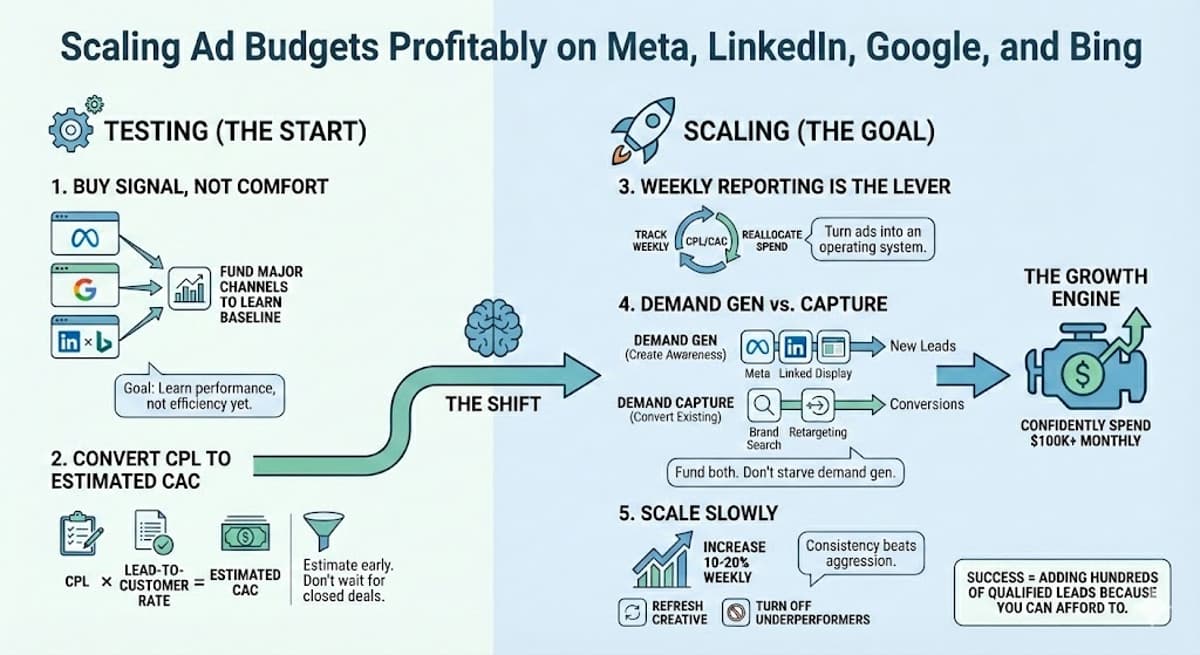
Scaling ad spend in B2B SaaS requires a mindset shift from short‑term testing to long‑term system building. Marketers must allocate sufficient budget to each major platform—Meta, LinkedIn, Google Search, Display, YouTube, and even Bing—to collect statistically meaningful data. This “signal‑first” approach eliminates guesswork, allowing teams to calculate true cost‑per‑lead (CPL) and, by applying historic conversion rates, estimate a directional customer acquisition cost (CAC) far earlier than waiting for closed‑won revenue. Early CAC visibility lets decision‑makers allocate capital to the most efficient channels while preserving cash flow.
Once reliable metrics exist, discipline becomes the growth lever. Weekly, standardized reporting across all accounts surfaces the exact spend, CPL, CAC, and trend data needed to reallocate dollars in near real‑time. Consistent cadence transforms advertising into an operating system rather than a series of ad‑hoc experiments. This process also clarifies the distinct roles of demand generation—prospecting on Meta and LinkedIn—to create new pipeline, versus demand capture—brand search and retargeting—that converts existing interest at lower CPLs. Balancing both ensures a healthy funnel and prevents over‑reliance on cheap but finite capture traffic.
Finally, scaling must be incremental. The industry consensus is to raise winning campaign budgets by 10‑20% each week, refreshing creative every four to six weeks, and shutting down underperforming ads rather than endlessly tweaking them. Sudden budget spikes reset platform learning phases and can erode performance. By combining data‑driven CAC estimation, weekly performance reviews, and measured budget growth, SaaS companies can confidently spend six‑figures monthly on ads, turning a once‑experimental channel into a core engine for multi‑million‑dollar ARR growth.
Scaling Ad Budgets Profitably on Meta, LinkedIn, Google, and Bing
0
Comments
Want to join the conversation?
Loading comments...