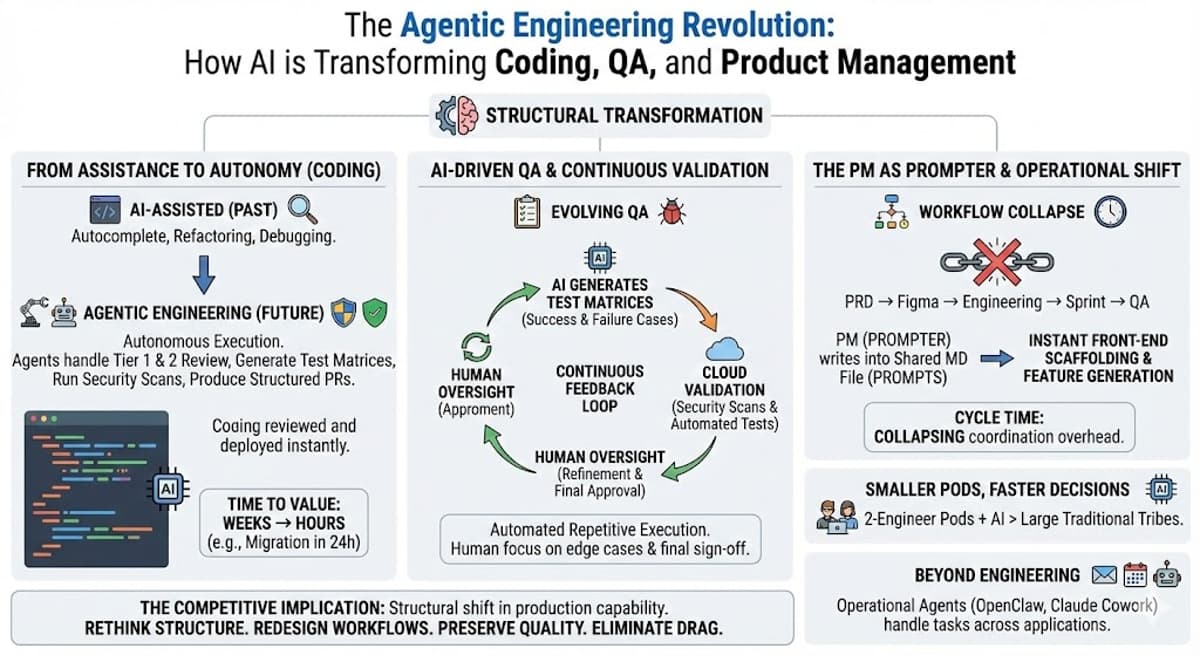
The Agentic Engineering Revolution: How AI Is Transforming Coding, QA, and Product Management
•February 21, 2026
0

Why It Matters
Agentic engineering turns AI into a strategic multiplier, accelerating product delivery and reducing traditional bottlenecks, which reshapes market dynamics and talent utilization.
Key Takeaways
- •AI agents automate code reviews and test generation.
- •Product managers now act as prompt engineers.
- •Smaller pods replace large tribes for faster decisions.
- •AI extends beyond coding to onboarding and workflow automation.
- •Early adopters gain competitive edge through accelerated delivery.
Pulse Analysis
The rise of agentic engineering marks a transition from supportive tools to autonomous software actors. By embedding AI agents that can review code, generate comprehensive test matrices, and enforce security policies, teams eliminate repetitive validation steps and free engineers to focus on architecture and innovation. This automation not only compresses development cycles—evidenced by a month‑long Angular migration completed in a single day—but also creates a new layer of reliability, as AI‑driven checks operate consistently at scale.
Product management is undergoing a parallel transformation. Prompt‑driven development lets PMs encode requirements directly into shared markdown files, triggering instant UI scaffolding and functional prototypes. The traditional handoff of lengthy specifications gives way to real‑time iteration, enabling sales teams to showcase working mock‑ups during live calls and close deals faster. This shift redefines the PM role from document custodian to system designer, demanding fluency in prompt engineering and AI workflow orchestration.
Organizationally, the speed gains compel a rethink of team structures. Large, hierarchical tribes become liabilities as alignment overhead outweighs the benefits of scale. Companies are gravitating toward lean pods that can make rapid decisions, while AI extends its reach beyond code to onboarding, email triage, and cross‑functional workflow automation. Early adopters that embed these agents across product, QA, and operations create a compounding advantage, turning AI from a tool into a competitive multiplier that reshapes industry standards.
The Agentic Engineering Revolution: How AI is Transforming Coding, QA, and Product Management
0
Comments
Want to join the conversation?
Loading comments...