
Why It Matters
Agent‑driven interactions will redefine SaaS distribution, making machine‑readable contracts a competitive moat. Companies that embed MCP now will capture the next wave of automated demand and avoid being bypassed by autonomous workflows.
Key Takeaways
- •AI agents execute tasks without human clicks
- •MCP standardizes agent‑software communication
- •Agent‑native platforms will dominate future web access
- •SaaS products must expose machine‑readable capabilities
- •Marketing will shift toward algorithmic decision‑makers
Pulse Analysis
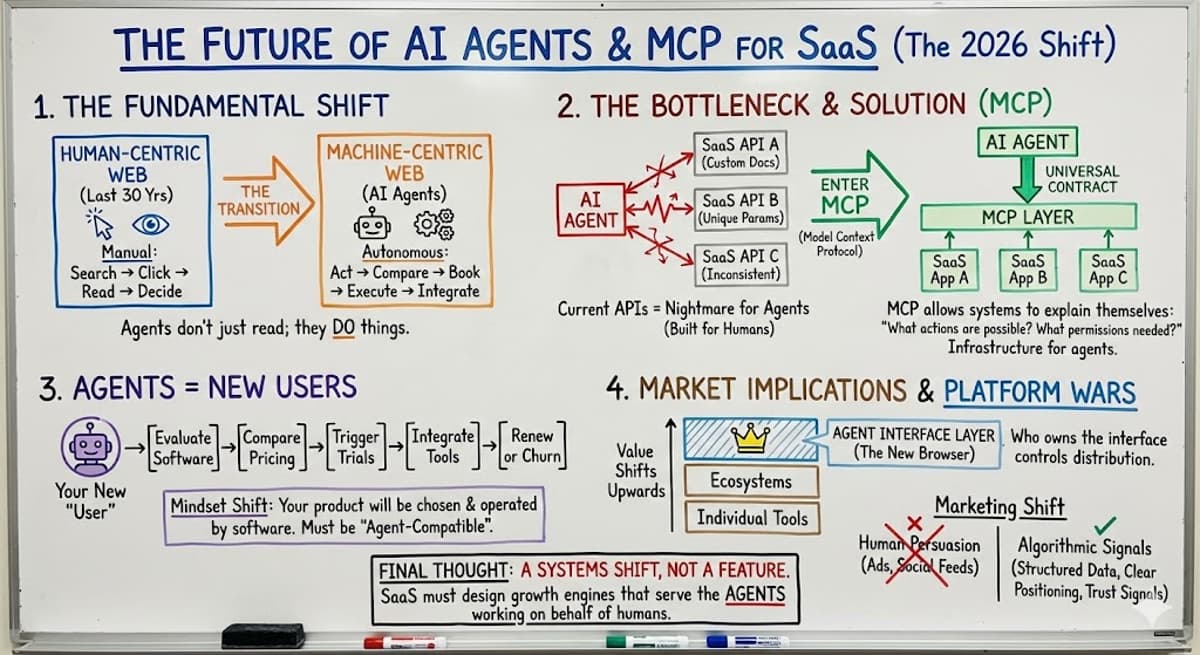
The emergence of AI agents marks a fundamental transition from a human‑centric UI to an agent‑centric operating system for the web. Unlike traditional search interfaces that stop at delivering answers, agents can perform end‑to‑end actions—booking flights, renewing subscriptions, or orchestrating multi‑tool workflows. This capability hinges on a shared language, and the Model Context Protocol (MCP) aims to provide it by describing a service’s actions, required permissions, and possible outcomes in a machine‑readable format. By eliminating the need for bespoke API documentation, MCP enables agents to interact with thousands of SaaS products at scale.
For SaaS founders, the implications are immediate. Products that expose MCP‑compliant contracts become plug‑and‑play for autonomous agents, gaining a distribution advantage similar to early browsers or app stores. This shifts the competitive battleground to the "agent layer"—the platform that mediates between user intent and software execution. Companies that ignore this risk being disintermediated, while those that design agent‑ready interfaces can capture automated usage, higher engagement, and new revenue streams. Safety mechanisms such as scoped permissions and human‑in‑the‑loop approvals will also become differentiators, building trust in an environment where agents act on behalf of users.
Marketing strategies must evolve alongside the technology. Traditional tactics that chase human attention—SEO, social ads, content—will be supplemented by structured data, clear value schemas, and performance signals that agents can parse and rank. Brands will need to present their offerings in a way that algorithmic decision‑makers can evaluate, compare, and select automatically. At the same time, founders must address risks of erroneous actions, data leakage, and manipulation by implementing robust governance frameworks. By aligning product design, go‑to‑market, and risk management with the agent‑first paradigm, SaaS companies can position themselves for sustained growth in the coming decade.
The Future of AI Agents and MCP for SaaS
0
Comments
Want to join the conversation?
Loading comments...