The Hidden Risk of Single-Developer Dependency in SaaS Companies
•January 14, 2026
0

Why It Matters
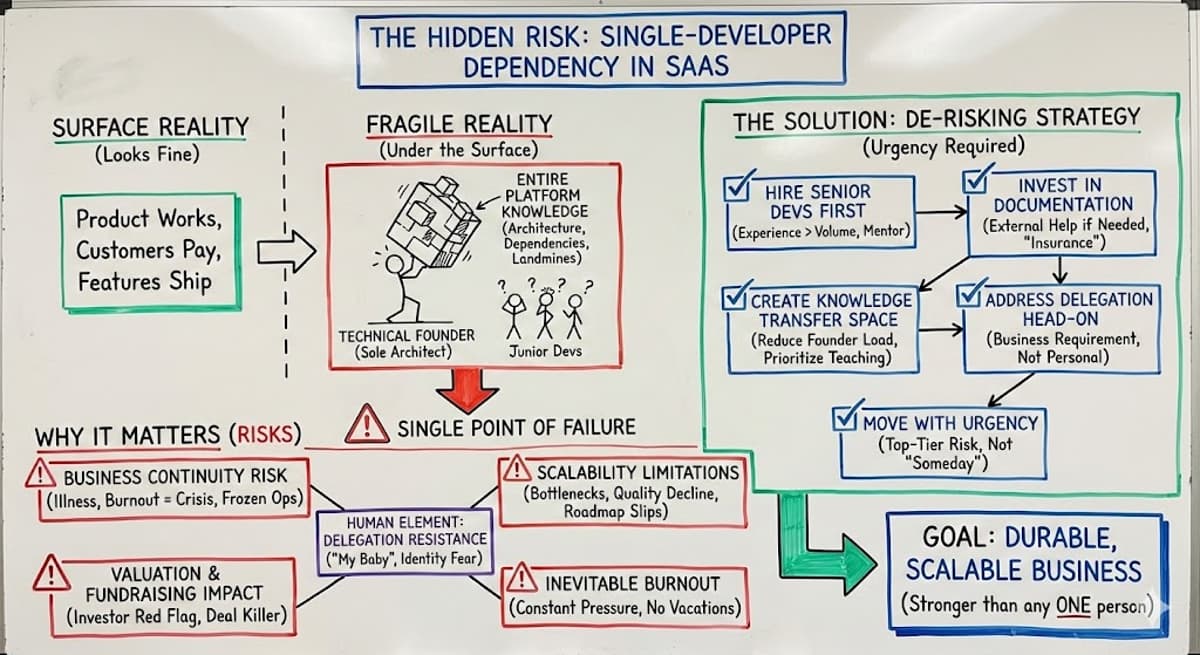
When all technical insight resides in one person, any disruption can stall product delivery, erode investor confidence, and lower company valuation, making the risk a strategic priority for SaaS leaders.
Key Takeaways
- •Knowledge concentrated in one founder creates single point of failure.
- •Investors view developer dependency as high‑risk during diligence.
- •Senior hires and documentation reduce bottlenecks faster than junior swarms.
- •Delegation resistance harms scalability and increases burnout risk.
- •Urgent knowledge transfer safeguards continuity and valuation.
Pulse Analysis
The hidden danger of single‑developer dependency often goes unnoticed because the product appears to work and revenue flows. Yet when a technical founder holds the majority of architectural insight, the organization lacks redundancy. Operational continuity becomes fragile; a sudden illness, burnout, or departure can freeze development pipelines, delay feature releases, and jeopardize customer satisfaction. This risk is especially acute in SaaS environments where continuous delivery and rapid iteration are expected.
Investors and acquirers scrutinize founder‑centric codebases during diligence, flagging them as high‑risk assets. A platform without documented processes or distributed knowledge signals potential integration challenges and future maintenance costs, which can depress valuations or even derail funding rounds. Moreover, the bottleneck created by a lone technical leader hampers scaling efforts, inflates bug rates, and accelerates burnout, further eroding team morale and market competitiveness.
Mitigating this risk requires a focused, urgent approach rather than a scattershot hiring spree. Bringing in senior engineers accelerates knowledge diffusion, as they can quickly grasp complex systems, mentor junior staff, and champion documentation standards. Structured knowledge‑transfer sessions, paired programming, and dedicated documentation projects create institutional memory that survives personnel changes. By confronting delegation resistance and prioritizing resilience over short‑term velocity, SaaS companies build a more robust foundation, protect their valuation, and position themselves for sustainable growth.
The Hidden Risk of Single-Developer Dependency in SaaS Companies
0
Comments
Want to join the conversation?
Loading comments...