

Why It Matters
By slashing development latency, companies can test market hypotheses faster and allocate engineering talent to high‑value scalability work, reshaping SaaS economics and team structures.
Key Takeaways
- •AI agents cut SaaS prototyping time from weeks to hours.
- •First‑pass code built by product owners, not engineers.
- •Supabase and Vercel provide instant backend and deployment.
- •Judgment, not implementation speed, becomes competitive advantage.
- •Figma mockups are being replaced by AI‑generated UI.
Pulse Analysis
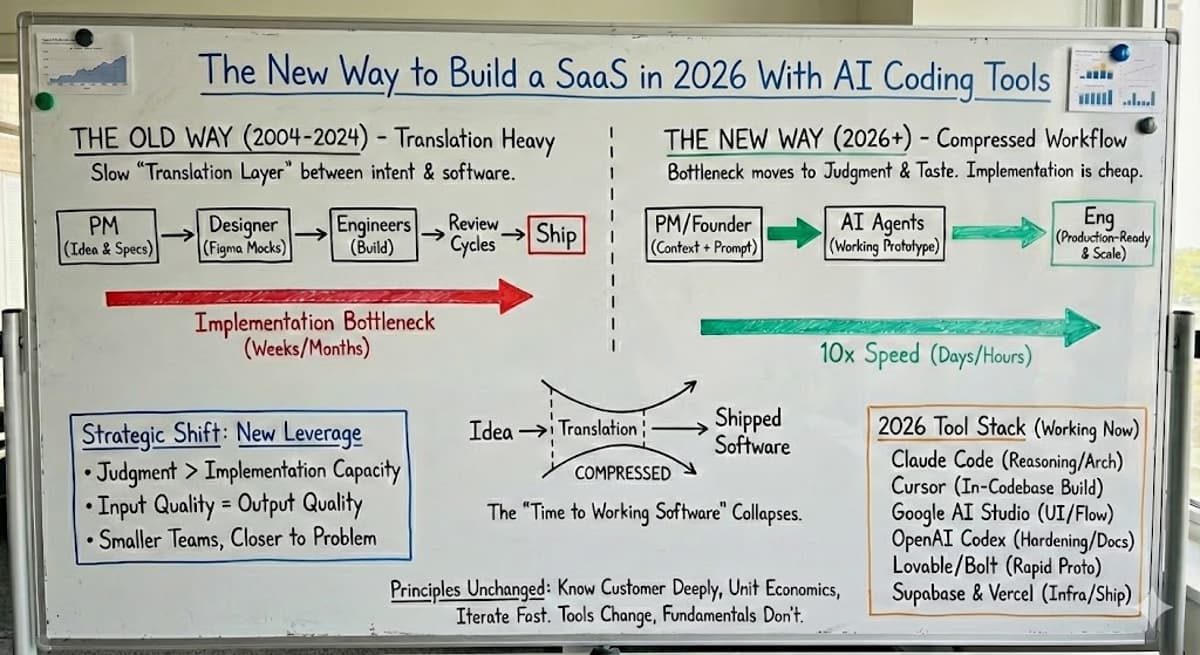
The most striking change in 2026 SaaS development is the compression of the translation layer that once separated product intent from code. Where a product manager previously spent weeks drafting specs and designers crafted Figma mockups, AI agents now generate a functional prototype in hours. This acceleration enables rapid validation of market hypotheses, turning what used to be a quarterly cycle into a weekly feedback loop, and dramatically reduces the cost of experimenting with new features.
The practical engine behind this shift is a modular AI stack. Claude Code excels at structuring backend logic, while Cursor acts as an AI pair‑programmer inside the live codebase. Google AI Studio produces UI components that often replace early‑stage design tools, and OpenAI Codex refines the output for production quality. Rapid‑deployment platforms like Bolt, Supabase, and Vercel turn generated code into live applications instantly, allowing teams to iterate without committing to a permanent tech stack. The flexibility to swap tools per task keeps development nimble and cost‑effective.
Organizationally, the new model rewards deep customer understanding over sheer engineering bandwidth. Product managers and founders who can craft precise problem statements and contextual prompts become the primary drivers of innovation, while engineers focus on scalability, security, and performance. Roles centered on document translation shrink, and judgment—knowing which ideas merit execution—emerges as the scarce resource. For SaaS CEOs, embracing this workflow means restructuring teams around empathy and rapid prototyping, ultimately delivering value to users faster and preserving margins in an increasingly competitive market.
The New Way to Build a SaaS in 2026 With AI Coding Tools
0
Comments
Want to join the conversation?
Loading comments...