The Specific Results From the B2B SaaS Growth Program That Just Finished
•February 23, 2026
0

Why It Matters
By turning fragmented tactics into a data‑driven engine, SaaS firms cut months of costly testing and accelerate revenue growth, setting a new efficiency benchmark for the industry.
Key Takeaways
- •Cohort achieved sub‑$15 CPL leads at scale
- •Integrated ABM, outbound, and retargeting created a growth engine
- •Weekly CPL tracking enabled data‑driven budget reallocation
- •Small UI tweaks boosted booked calls dramatically
- •Companies now know exact CAC and payback windows
Pulse Analysis
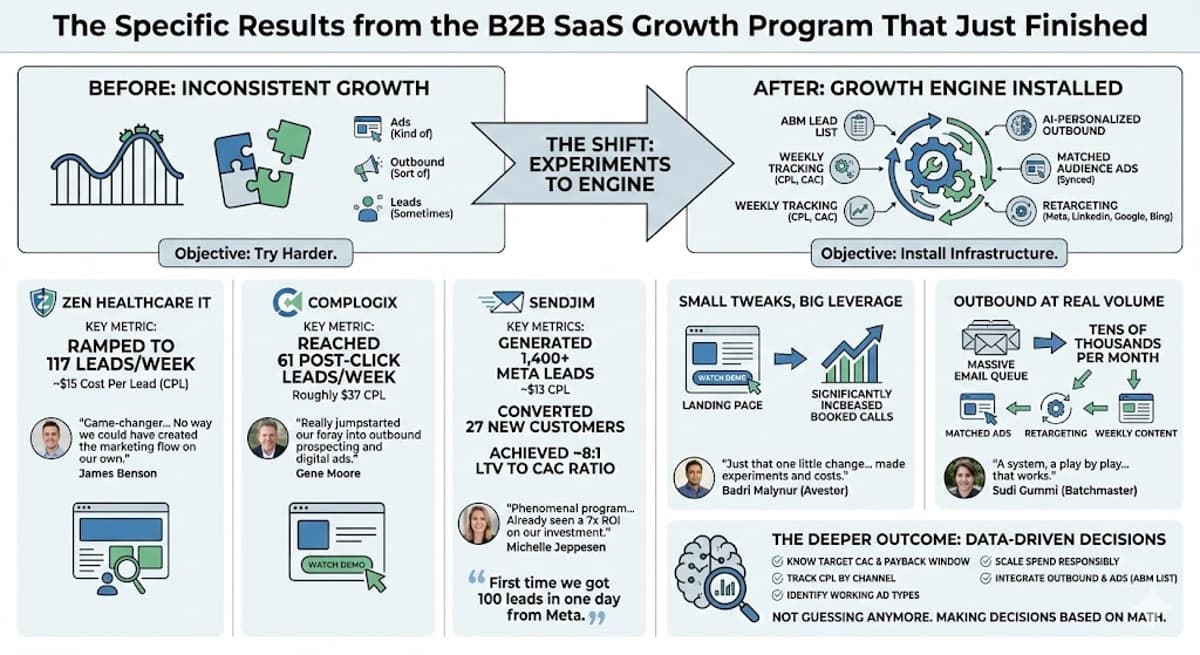
The shift from isolated marketing experiments to an integrated growth engine reflects a maturing B2B SaaS landscape where infrastructure outweighs sheer spend. By aligning ABM lists with AI‑personalized outbound emails, matched‑audience ads, and retargeting across Meta, LinkedIn, Google, and Bing, the program gave companies a single source of truth for cost‑per‑lead and customer‑acquisition metrics. Weekly tracking turned opaque spend into actionable data, allowing founders to reallocate budgets in real time and maintain a disciplined payback window.
Concrete outcomes underscore the financial upside of this systematic approach. Zen Healthcare IT’s 117 leads at $15 CPL, CompLogix’s 61 leads at $37 CPL, and SendJim’s 1,400 Meta leads at $13 CPL—all achieved without inflating budgets—demonstrate that scale does not have to come at the expense of efficiency. SendJim’s 8:1 LTV‑to‑CAC ratio and reported 7× ROI illustrate how precise CAC knowledge can unlock profitable growth, even for companies targeting $50M+ ARR. Moreover, modest UI changes, such as adding a “Watch Demo” button, proved that incremental optimizations can yield outsized call‑booking lifts.
For the broader SaaS market, the program’s results signal a strategic imperative: success will belong to firms that define their ideal customer profile, synchronize outbound and paid channels, and institutionalize weekly performance reviews. This disciplined, math‑first mindset reduces the typical six‑to‑twelve‑month testing cycle, accelerates go‑to‑market velocity, and creates a scalable engine capable of adapting to market shifts. Companies that adopt this framework are poised to outpace competitors who remain reliant on fragmented, trial‑and‑error tactics.
The Specific Results from the B2B SaaS Growth Program That Just Finished
0
Comments
Want to join the conversation?
Loading comments...