
Companies Mentioned


Why It Matters
These capital infusions and consolidations validate AI as the core growth engine for SaaS, while the shift to AI‑first operations promises lower costs and faster scaling for providers.
Key Takeaways
- •AI agents reshaping SaaS sales and operations.
- •Moonshot AI leads $500M Series C funding.
- •Meta acquires Manus, boosting autonomous AI tools.
- •SaaS IPO pipeline expands in India and US.
- •Retail and life‑sciences SaaS attract sizable VC capital.
Pulse Analysis
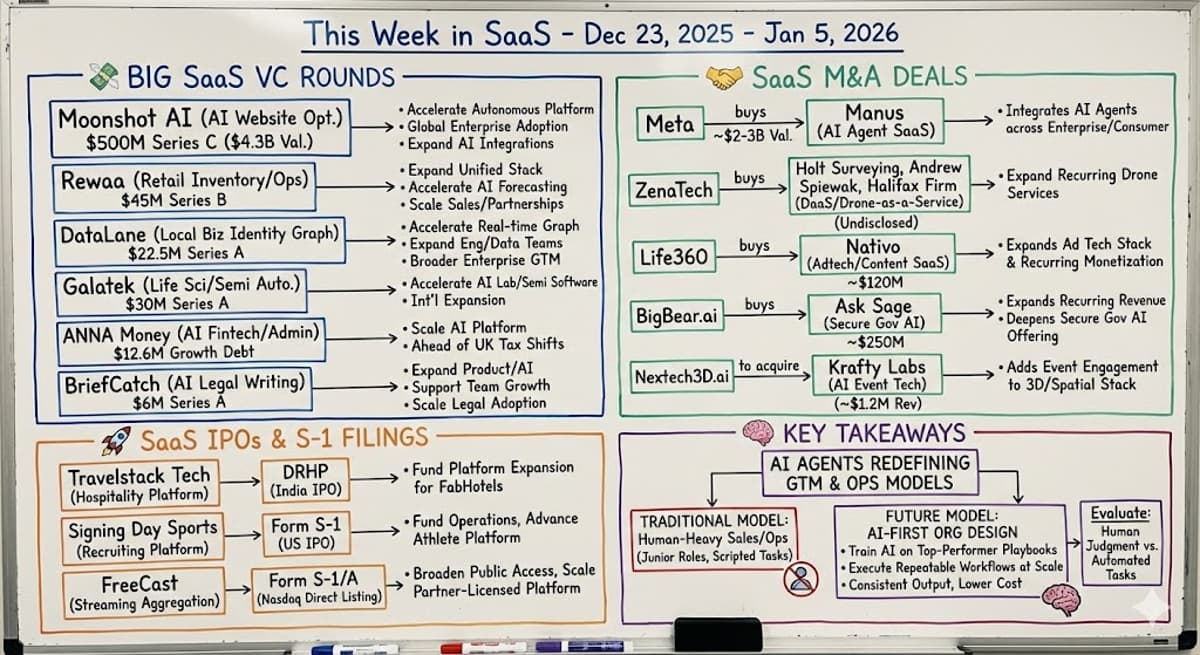
The recent surge in AI‑centric funding reflects a broader market belief that artificial intelligence is no longer a differentiator but a necessity for SaaS growth. Moonshot AI’s $500 M Series C, alongside mid‑stage rounds for Rewaa, DataLane and Galatek, illustrates investors’ appetite for platforms that embed autonomous optimization, demand forecasting and lab automation directly into the product stack. This capital influx enables rapid feature development, global expansion, and the hiring of specialized engineering talent, positioning these companies to capture enterprise contracts that demand AI‑powered efficiency.
M&A activity further confirms the strategic value of AI integration. Meta’s multi‑billion‑dollar purchase of Manus adds a subscription‑based AI agent platform to its ecosystem, accelerating its push into autonomous tools for creators and advertisers. Similarly, BigBear.ai’s acquisition of Ask Sage brings a secure generative‑AI solution tailored for government workloads, expanding its recurring‑revenue portfolio. Smaller deals, such as Life360’s $120 M buy of Nativo and Nextech3D.ai’s acquisition of Krafty Labs, highlight how niche SaaS firms are bundling AI‑augmented capabilities to broaden addressable markets and create cross‑selling opportunities.
The IPO pipeline signals that public markets remain receptive to SaaS innovators, especially those with strong AI roadmaps. Travelstack Tech’s DRHP filing in India and FreeCast’s Nasdaq direct‑listing amendment demonstrate geographic diversification of capital sources, while Signing Day Sports prepares to leverage its athlete‑recruitment platform for broader monetization. For founders, the convergence of deep‑pocket financing, strategic acquisitions, and public‑market readiness underscores the imperative to embed AI at the core of product and operational design, ensuring scalability, cost efficiency, and sustained investor interest.
This Week in SaaS - Dec 22, 2025 - Jan 5, 2026
0
Comments
Want to join the conversation?
Loading comments...