What Is a Good Monthly and Annual Churn Rate for a SaaS Company?
•January 29, 2026
0

Why It Matters
Understanding churn by revenue tier and its drivers lets SaaS CEOs protect unit economics, sustain growth, and avoid costly mis‑diagnoses that can stall scaling.
Key Takeaways
- •ACV tier dictates realistic churn benchmarks
- •Involuntary churn often stems from budget cycles
- •Net Revenue Retention offsets churn impact
- •ICP‑adjusted churn reveals targeting inefficiencies
- •Churn headwind grows as customer base scales
Pulse Analysis
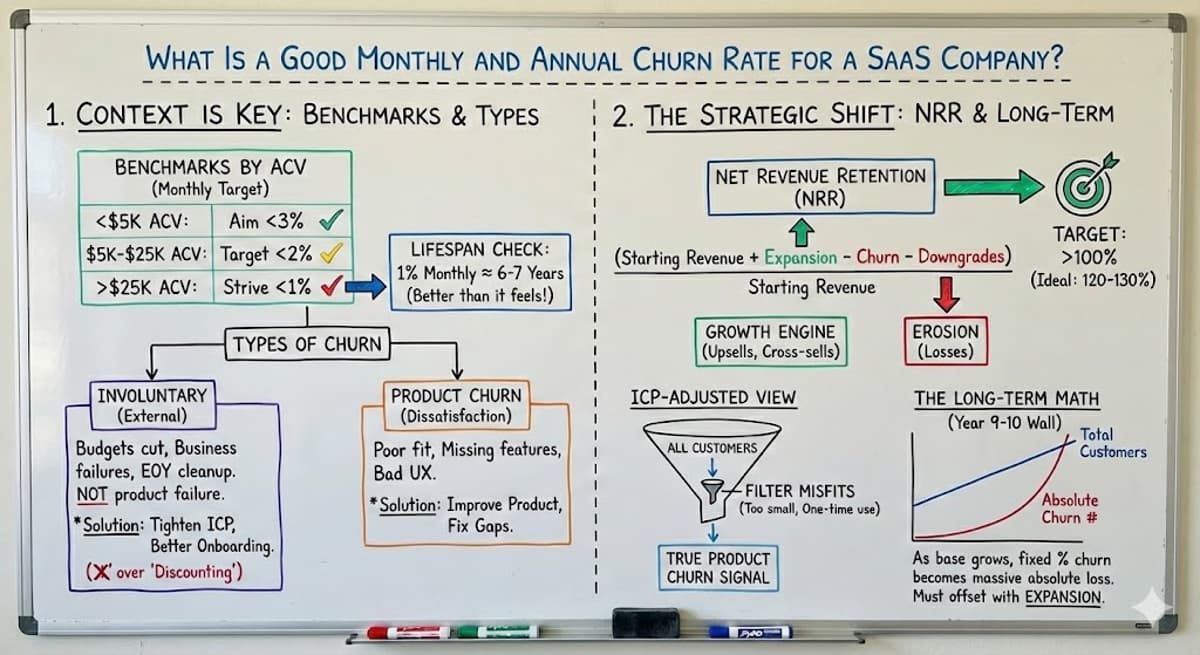
Churn is a universal SaaS challenge, but its significance shifts with the size of the contract. Companies selling low‑ticket, self‑serve solutions typically tolerate higher monthly attrition because each lost customer represents a modest revenue slice. In contrast, mid‑market and enterprise vendors with $10K‑$25K ACV must keep churn under 2% monthly to preserve multi‑year customer lifetimes and maintain healthy cash flow. Benchmarking against these ACV‑specific ranges prevents founders from chasing unrealistic targets and provides a clear baseline for performance reviews.
Beyond the raw churn number, the real health indicator is Net Revenue Retention (NRR). NRR captures both the loss from churn and the gain from upsells, cross‑sells, and expansions. A SaaS firm that can achieve 100%+ NRR each month effectively neutralizes churn, turning the existing base into a growth engine. Leaders should therefore align customer‑success incentives with expansion metrics, tighten onboarding to filter out poor‑fit prospects, and prioritize expansion revenue to keep the overall revenue trajectory positive even when some logos leave for involuntary reasons.
As a SaaS business scales, the absolute volume of churned customers rises, turning churn into a growing headwind. Adjusting churn calculations to reflect the Ideal Customer Profile (ICP) helps isolate structural churn from product‑related issues, ensuring that strategic decisions target the right levers. Early adoption of ICP‑adjusted churn, combined with a relentless focus on NRR, equips companies to navigate the inevitable churn increase that comes with a larger customer base, preserving compounding growth well into the ninth or tenth year.
What Is a Good Monthly and Annual Churn Rate for a SaaS Company?
0
Comments
Want to join the conversation?
Loading comments...