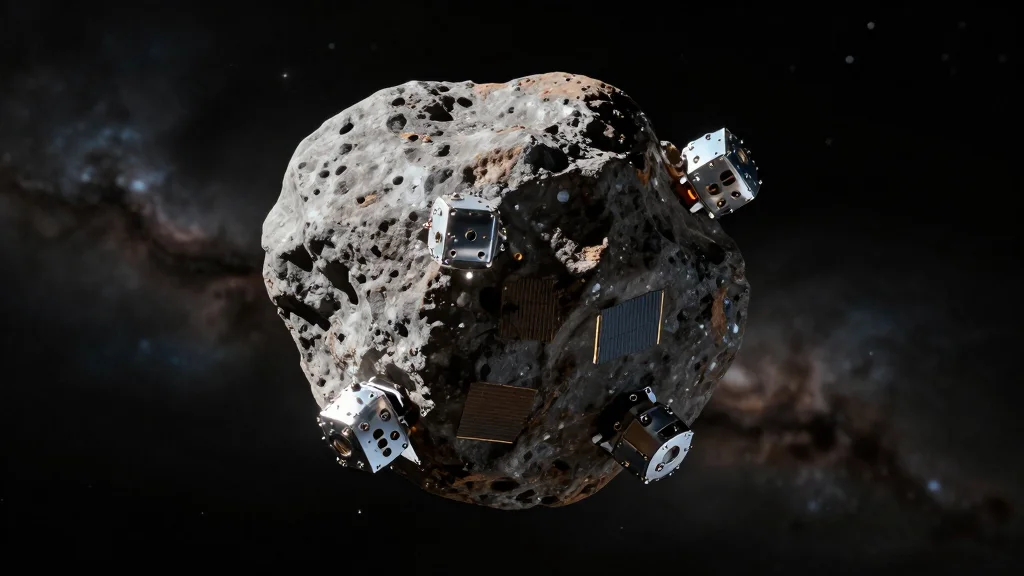
Meet REMORA: The Autonomous Space Fleet Built to Tag and Track Asteroids
Why It Matters
In‑situ asteroid characterization dramatically improves impact prediction and resource assessment, filling a critical gap in planetary‑defence capabilities. The low‑cost, autonomous approach could make deep‑space science accessible to both public agencies and commercial players.
Key Takeaways
- •REMORA proposes six CubeSats to rendezvous with near‑Earth asteroids
- •Mission budget targets €50 million (~$55 million), a Mini‑F class cost
- •Autonomous NEAR software enables fuel‑optimal navigation without ground control
- •UK’s Surrey and Liverpool facilities offer low‑cost testing, launch partners
Pulse Analysis
Asteroid threats have moved from theoretical to practical concerns, highlighted by events like the 2013 Chelyabinsk airburst and the upcoming 2029 close approach of 350‑meter Apophis. While telescopic surveys and orbital observatories map trajectories, they cannot reveal composition, internal structure, or surface mechanics—data essential for accurate deflection strategies and for evaluating mining potential. Past missions such as NASA’s DART and OSIRIS‑Rex demonstrated the scientific payoff of direct interaction, yet their high costs and single‑target focus leave a capability gap that a distributed, low‑cost system could fill.
REMORA’s architecture tackles that gap by deploying a swarm of six CubeSats, each capable of attaching to or tightly orbiting an asteroid to conduct high‑resolution spectroscopy, gravimetry, and imaging. The NEAR software suite—comprising dynNEAR for dynamic modeling and goNEAR for autonomous pathfinding—calculates fuel‑minimal maneuvers on‑board, eliminating the need for a large ground‑control team. By anchoring development in the UK’s Zero‑G Astrolab for hardware‑in‑the‑loop testing and partnering with Surrey Satellite Technology Ltd’s proven small‑sat launch services, the mission stays within a Mini‑F budget of roughly $55 million, a fraction of traditional flagship costs.
If realized, REMORA could reshape planetary‑defence planning by providing real‑time, on‑site data for asteroids approaching from sunward blind spots, enhancing early‑warning systems ahead of the International Year of Asteroid Awareness in 2029. The same data stream would also inform the nascent space‑resource economy, offering commercial stakeholders detailed material inventories. While funding remains uncertain, the mission’s cost‑effective, autonomous model presents an attractive template for both government agencies and private investors seeking to de‑risk deep‑space operations.
Meet REMORA: The autonomous space fleet built to tag and track asteroids
Comments
Want to join the conversation?
Loading comments...