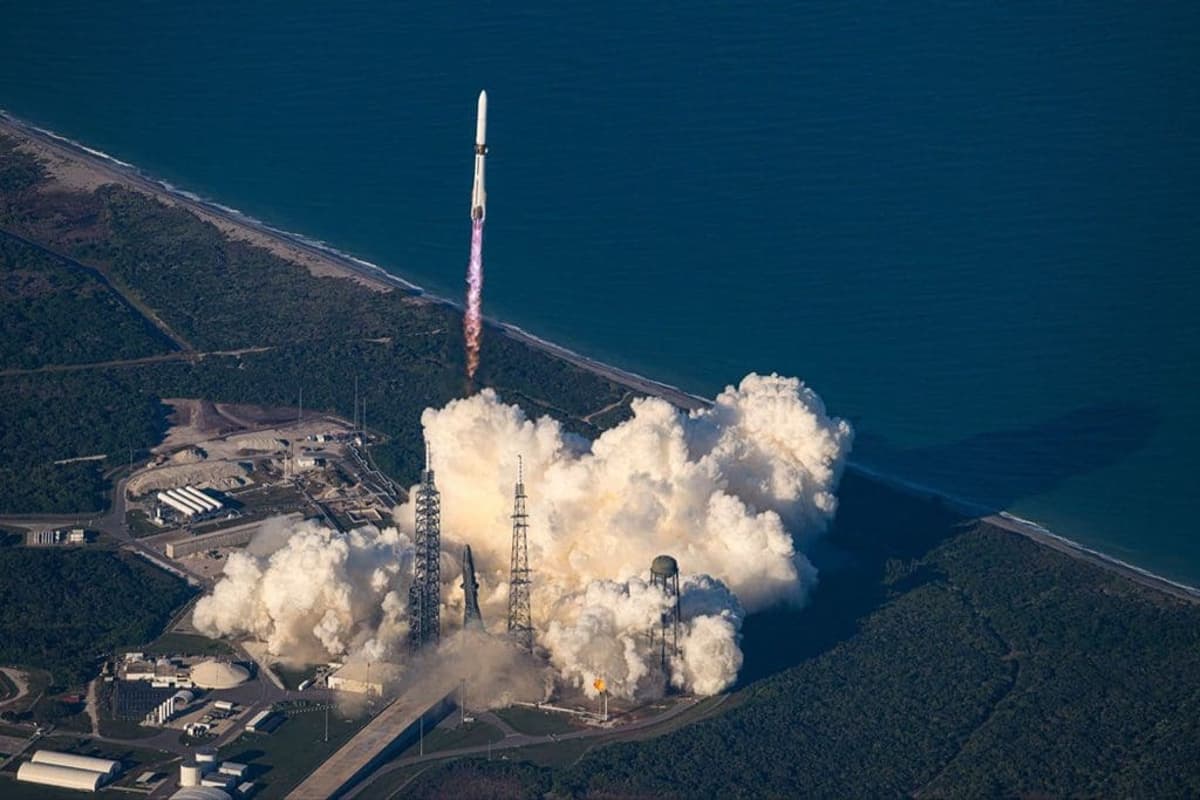
NASA ESCAPADE Will Study Space Weather From Earth to Mars
•March 12, 2026
0
Key Takeaways
- •First dual-orbiter mission around Mars
- •Measures atmospheric escape with two‑minute resolution
- •Uses Lagrange Point 2 loiter for Earth magnetotail study
- •Data will guide Mars crew radiation safety protocols
- •Supports future Mars ionosphere communication systems
Summary
NASA’s ESCAPADE mission has activated its twin science instruments to study how the solar wind stripped Mars of its atmosphere, turning a once‑wet world into a barren desert. Launched on 13 Nov 2025, the dual‑orbiter pair is the first to operate together around another planet, delivering two‑minute temporal resolution of magnetospheric changes. After an initial co‑orbital phase, the spacecraft will separate to sample both the solar wind and Mars’ magnetosphere simultaneously. The data will feed space‑weather protocols for future human missions and improve Mars communication system designs.
Pulse Analysis
The ESCAPADE mission marks a paradigm shift in planetary science by deploying two coordinated spacecraft around Mars, a capability previously limited to Earth. By maintaining a tight formation for six months, the duo captures rapid fluctuations in the Martian magnetosphere that single‑satellite missions could never resolve. When the orbiters diverge, they simultaneously monitor upstream solar wind conditions and downstream atmospheric response, delivering a true "stereo" view of cause and effect. This architecture not only refines models of atmospheric escape but also sets a new standard for multi‑point measurements in deep‑space exploration.
Solar‑wind stripping has long been identified as the primary driver behind Mars’ transition from a potentially habitable planet to its current thin, cold state. ESCAPADE’s high‑resolution observations will quantify how energetic particles erode the ionosphere and accelerate loss of volatile gases. The mission’s focus on the hybrid magnetosphere—a patchwork of weak crustal fields and induced currents—directly informs radiation risk assessments for future crews. By characterizing ionospheric density and variability, ESCAPADE also underpins the development of reliable radio, navigation, and even GPS‑like services essential for surface operations.
Beyond Mars, ESCAPADE’s launch profile showcases innovative mission design. After departing on a New Glenn rocket, the spacecraft loitered at Lagrange Point 2, gathering unprecedented data on Earth’s distant magnetotail before a gravity‑assist to Mars. This dual‑purpose trajectory demonstrates how interplanetary missions can serve both destination science and heliophysics research, reducing overall cost and expanding scientific return. The approach paves the way for future multi‑destination probes and commercial ventures seeking flexible launch windows while contributing valuable space‑weather insights that benefit satellite operators and astronaut safety across the solar system.
Comments
Want to join the conversation?