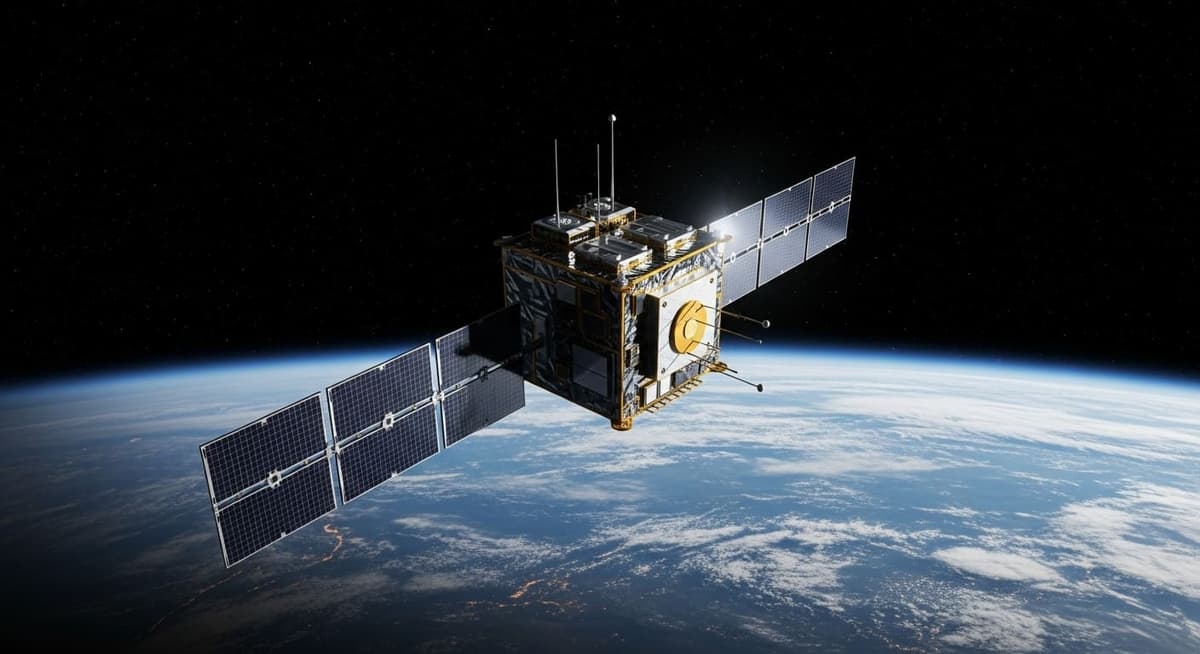
Satellite Quantum-Internet to Reach $1.82B in 2026 with 32.9% CAGR
•January 28, 2026
0
Why It Matters
The rapid growth signals a shift toward quantum‑safe communications, making satellite quantum‑internet a critical infrastructure for protecting high‑value data against emerging cyber threats. This creates sizable opportunities for vendors and investors in quantum hardware, encryption services, and satellite constellations.
Key Takeaways
- •Market $1.82B in 2026, 32.9% CAGR
- •Defense, finance lead early adoption
- •Asia‑Pacific fastest growth region
- •Quantum key distribution drives satellite networks
- •Cybercrime up 23% fuels demand
Pulse Analysis
The satellite quantum‑internet is emerging as the next frontier in secure global communications, marrying the long‑distance reach of space‑based platforms with the theoretically unbreakable security of quantum key distribution (QKD). According to a recent ResearchAndMarkets.com forecast, revenues will climb from $1.37 billion in 2025 to $1.82 billion in 2026, a 32.9 % compound annual growth rate, and are projected to hit $5.63 billion by 2030. This trajectory reflects not only the maturation of quantum hardware—such as photon‑efficient sources and quantum repeaters—but also the scaling of satellite constellations capable of delivering quantum‑encrypted links across continents.
Two forces are accelerating this expansion. First, successful in‑orbit QKD demonstrations have proven that quantum keys can be generated and exchanged over hundreds of kilometers of free‑space, prompting defense agencies and financial firms to pilot quantum‑secure channels for mission‑critical data. Second, a 23 % rise in reported cybercrime incidents between 2022 and 2023 has heightened urgency for quantum‑safe encryption, especially in regions vulnerable to sophisticated attacks. North America currently commands the largest market share, yet the Asia‑Pacific region is expected to outpace peers as governments and telecom operators pour capital into quantum satellite programs.
The market outlook translates into concrete opportunities for hardware manufacturers, satellite operators, and service integrators. Companies like IonQ, bolstered by its acquisition of ID Quantique, are building end‑to‑end quantum networking stacks that combine ground‑station receivers with space‑borne transmitters. Venture capital is flowing into start‑ups focused on high‑precision optical terminals and quantum memory repeaters, while traditional aerospace firms are forming joint ventures to accelerate deployment schedules. However, challenges remain: regulatory frameworks for quantum spectrum use, the high cost of launch, and the need for interoperable standards. Overcoming these hurdles will be essential for the satellite quantum‑internet to become a mainstream backbone of cyber‑resilient infrastructure.
Satellite Quantum-Internet to Reach $1.82B in 2026 with 32.9% CAGR
0
Comments
Want to join the conversation?
Loading comments...