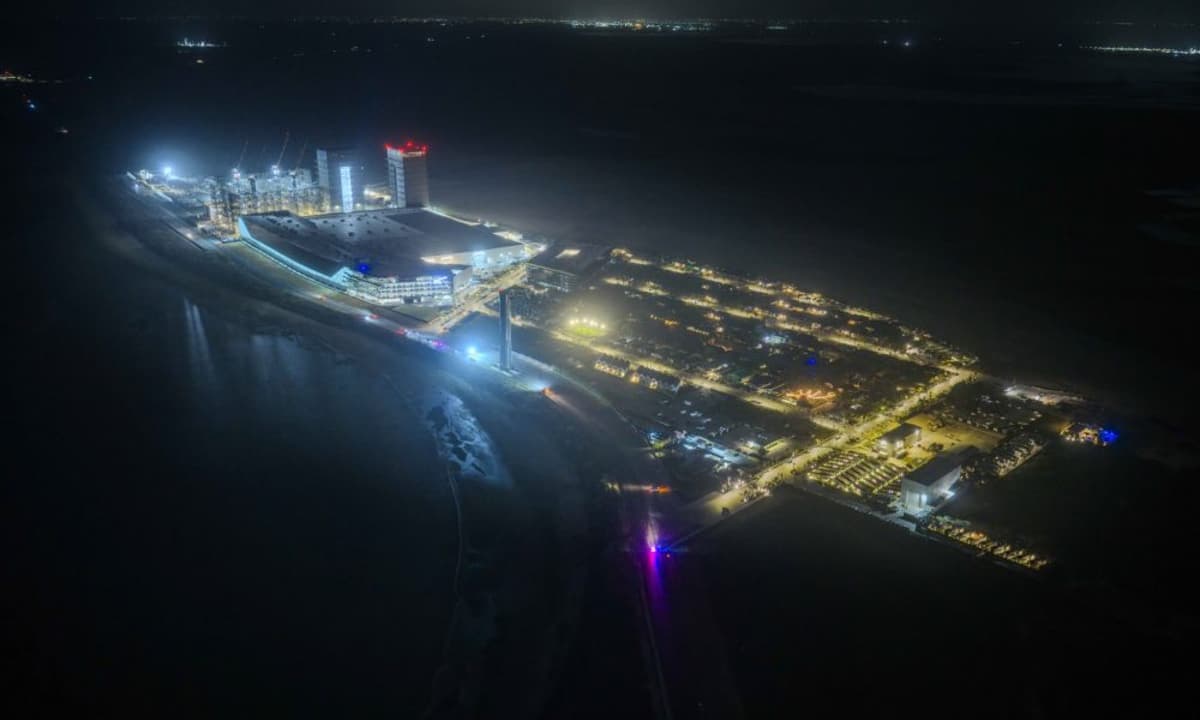
Starbase After Dark: Musk’s Latest Photo Captures a Spaceport on the Brink of History
•March 10, 2026
0
Key Takeaways
- •Two 474‑ft Starship towers now fully erected
- •Pad 2 hardware nearing completion with 20 protected hold‑down arms
- •FAA permits up to 25 launches annually from Starbase
- •Starbase incorporated as Texas city, streamlining approvals
- •Site expansion adds LNG plant and larger propellant storage
Summary
Elon Musk’s recent night‑time photo of SpaceX’s Starbase reveals two fully erected Starship launch towers, including the 474‑foot OLIT‑3 on Pad B with a water‑cooled flame trench. Pad 2 is nearing hardware completion, featuring upgraded chopstick arms, a chill‑down vent system, and protected hold‑down arms for up to 33 Raptor 3 engines. The FAA has raised the launch allowance from five to twenty‑five flights per year, and Starbase was incorporated as a Texas city in May 2025, giving SpaceX direct control over local infrastructure. Ongoing site expansion adds LNG liquefaction, larger propellant storage, and additional ground support, signaling a shift from test site to high‑cadence spaceport.
Pulse Analysis
The visual confirmation of two towering launch structures at Starbase marks a pivotal moment in SpaceX’s infrastructure rollout. Tower OLIT‑3, standing 474 feet tall, integrates a water‑cooled flame trench designed to protect the pad and shorten turnaround times. Coupled with Pad 2’s near‑complete hardware—upgraded chopstick arms, a new chill‑down vent, and fully shielded hold‑down arms—the complex is engineered for high‑frequency launches, a prerequisite for Starship’s ambitious payload schedule.
Regulatory momentum amplifies the operational impact. By incorporating Starbase as a Texas municipality, SpaceX now navigates local governance directly, expediting permitting and infrastructure decisions. The FAA’s increase to twenty‑five annual launches further unlocks capacity for commercial satellite deployments, Department of Defense missions, and lunar logistics. These policy shifts not only reduce bureaucratic friction but also attract ancillary businesses, fostering an emerging aerospace ecosystem on the Gulf Coast.
Industry observers view Starbase’s evolution as a catalyst for broader market dynamics. The expanded footprint, featuring LNG liquefaction and enlarged propellant storage, signals readiness for sustained, large‑scale operations that could outpace traditional launch providers. As SpaceX pushes toward a self‑sustaining Mars presence, the ability to launch Starship at cadence will reshape supply chain economics, lower access costs, and pressure competitors to accelerate their own heavy‑lift capabilities. In this context, Starbase is transitioning from a testbed to a strategic spaceport that could redefine global launch infrastructure.
Comments
Want to join the conversation?