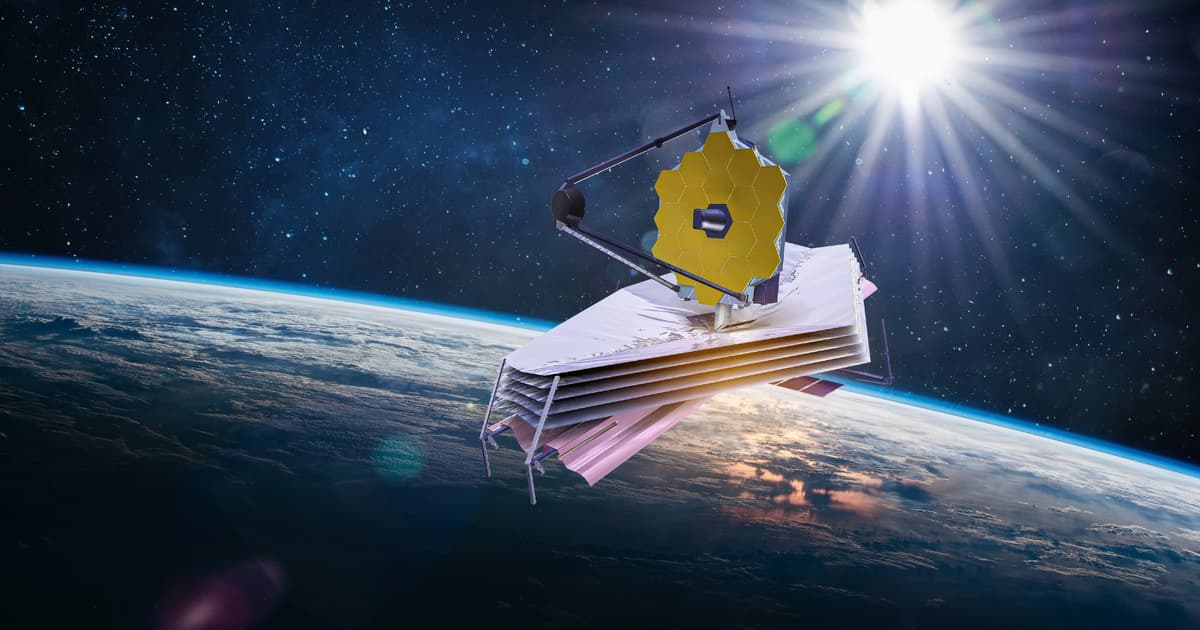
344 Steps Stood Between the James Webb Space Telescope and Total Failure — Any One Could Have Ended It — and the Telescope that Survived Them All Now Runs on Less Power than a Household Kettle, a Million Miles From Earth
Companies Mentioned

NASA
Why It Matters
Webb’s flawless navigation of hundreds of failure points proves that ultra‑complex, unmanned space observatories can succeed without on‑site repairs, setting a new benchmark for future deep‑space missions. Its low‑power, passive‑cooling design also demonstrates a sustainable model for long‑duration spacecraft.
Key Takeaways
- •Webb launched with 344 single‑point failure risks.
- •Sunshield deployment eliminated ~75% of those risks within two weeks.
- •Telescope operates on ~1 kW, less than a typical kettle.
- •Passive cooling via sunshield reduces power demand dramatically.
- •Orbiting L2, 1.5 million km away, prevents on‑site repairs.
Pulse Analysis
James Webb’s launch highlighted an engineering philosophy that embraces exhaustive risk enumeration. By cataloguing 344 single‑point failures—far more than typical spacecraft—NASA forced every mechanism, from release latches to cable reels, to meet a one‑time‑only reliability threshold. This rigorous approach, championed by mission systems lead Mike Menzel, turned a potential vulnerability into a proof point for high‑stakes, unmanned missions, reinforcing confidence in future projects like the Habitable Worlds Observatory.
The five‑layer sunshield, the centerpiece of Webb’s risk mitigation, serves a dual purpose: it safeguards delicate optics from solar heat and provides passive cooling that slashes power consumption. By shading the telescope, the shield keeps detector temperatures near 7 kelvin without active refrigeration, allowing the observatory to run on roughly one kilowatt—comparable to a modest kitchen appliance. This efficiency not only extends the spacecraft’s operational lifespan as solar panels degrade but also illustrates how thermal design can drive power savings in deep‑space platforms.
Positioned at the Sun‑Earth L2 libration point, Webb enjoys a stable thermal environment while remaining out of reach of any crewed rescue. The distance underscores the mission’s self‑reliance: every deployment had to succeed on first attempt. Since July 2022, Webb has delivered groundbreaking infrared data, reshaping our view of the early universe. Its success validates the feasibility of ambitious, remote observatories and informs the architecture of next‑generation telescopes that will probe exoplanets and cosmic origins from similarly distant, unmanned outposts.
344 steps stood between the James Webb Space Telescope and total failure — any one could have ended it — and the telescope that survived them all now runs on less power than a household kettle, a million miles from Earth
Comments
Want to join the conversation?
Loading comments...